Today, we are going to discuss the "Spring washers are used to prevent loosening and fallingHere is a note about "The
When I am designing mechanisms, I am separated from those who say "spring washers have no loosening effect" and those who say "they can be used as a loosening prevention.
Looseness Negative
Cited by NBK (What is the role of a washer?) from
I believe that spring washers have little or no effect in preventing loosening.The elastic force of the spring washer is very small compared to the axial force when the screw is tightened to the specified torque...omitted...It may be meaningful to prevent the screw from falling out easily by friction due to elastic force when the screw is loosened.
Anti-loosing affirmation group
Quote: From Utsunomiya Roshi (spring washers (spring washers))
The purpose of adding spring washers is to "prevent loosening" and to "prevent falling off" when they loosen....Omitted...Even if a screw assembled with a spring washer loosens, the repulsive force of the spring washer pushes against it and increases the frictional force, making it difficult for the screw or nut to come off.
Thus, some people say there is little or no loosening effect, while others say there is a loosening effect,I think I am right on both counts.
Maybe it is because few people use spring washers properly and with reason that topics such as, "Do spring washers have an anti-loosening effect?" and other such topics may be raised.In the first place, spring washers are not intended to have a loosening effect after fastening. But for me personally, I think it's a good idea.A spring washer is very convenient, isn't it? I think.
Depending on the way the sentence is written, if a young designer sees the information that spring washers have no loosening effect, he or she is likely to judge that spring washers are meaningless in any case.Some people think, "Isn't fall protection the same thing as a loosening stop?" In this article, we will discuss how to prevent the fall of a product,A little summary of the opinions of the negative and positive anti-loosening effects, and a note on the use of spring washers. I would like to do so.
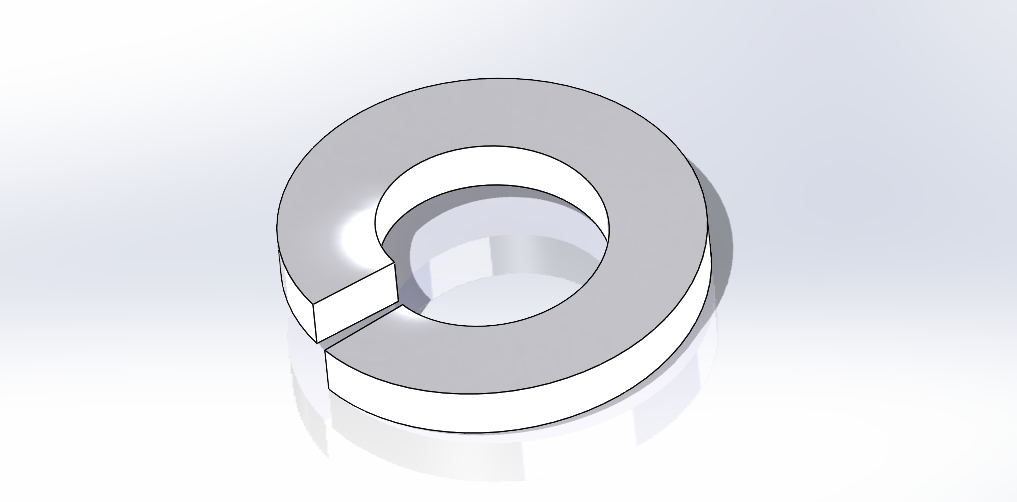
Spring washer applications focus on elastic force
The website of Heiwa Hojo Co., Ltd. explains the features of spring washers in an easy-to-understand manner.
Quote: From Heiwa Hojo Corporation (washers, spring washers)
With washers in the shape of one winding coil,The spring action of the tightening and flattening of the cutout portion provides an anti-loosening effect.It can be done.
In other words,SpringLoose washersThe spring washer is effective from the time it acts on the screw until the screw is fully tightened, and from the point where the spring washer is fully tightened until it loosens and exceeds its working range. I will do so.
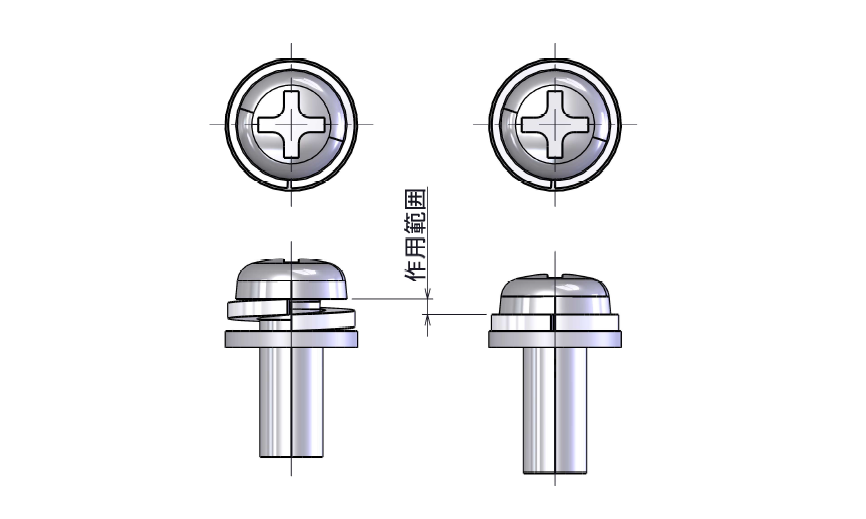
Hmmm... I feel like I've wasted a lot of time painting a picture, but spring washers are effective in this range, so what the naysayers and positives quoted at the beginning of this article are both correct.
in summary
- Until the screw is fully tightened, there is a pressing effect due to the action of the spring washer.When the screw is fully tightened, the axial force (pressing force) of the screw exceeds the pressing force of the spring washer, so the force exerted by the spring washer is small and hardly effective in preventing loosening of a screw that has been fully tightened.
- When a screw is loosened, the spring washer will press down on the screw if it is within the range of action of the spring washer, thus achieving a certain anti-loosening effect (anti-falling effect). However, it is not always possible to stop screws from loosening due to vibration
- Pressing effect when screws are loose.The pressing force of the spring washer is not standardized and cannot be guaranteed.
It is.
Application of Spring washer
This is a spring washer that produces a limited effect, though,Not if there is a spring washer in it. So, I will note in my experience how it is used.
(1) Place for fine-tuning
The first place where a spring washer is a good idea isA place where fine-tuning is done. It is.The elastic force of the spring washer is useful in assembly.When building a machine, assembly and adjustment occur in many places.
For example,If the board to be fastened is attached to the bottom side, the weight of the board will be applied and the board will fall down when the screws are loosened, making it difficult to adjust the location or the board,Where the board is standing and if you loosen the screws when adjusting it, it will fall down and create a gap,Locations where screws are tightened while holding down the part by handIt is.
The part where the screw is fastened from above does not basically need a spring washer, though, because the member does not float (move) under its own weight,It is recommended to have a flat washer in areas where front/rear/right/left adjustments are made (where a flat washer is used with a long hole). (Hexagon socket head cap screws, hexagon bolts, and other screws in general)
(2) Use for screws that are difficult to tighten
Spring washers are effective for screws that are difficult to close I think it is.
For example, a cross-holed pan head screw.
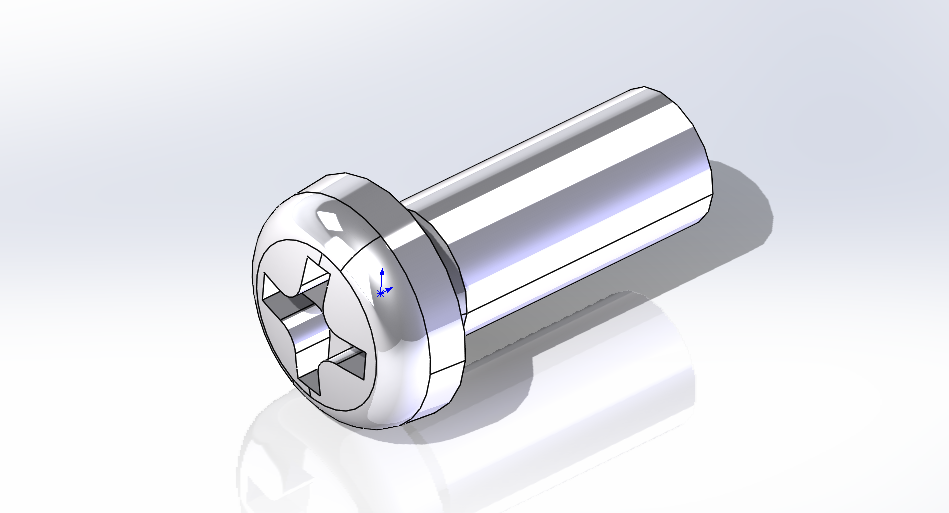
Many of the machine screws used by our designers and assembly engineers are hexagon socket head screws.While the feature is that it is easy to control torque for tightening screws, cross-hole bolts are difficult to tighten and torque control is relatively difficult. It is. Where tightening torque is difficult to control, axial force varies and loosening of screws is likely to occur.
These are cross-holed pan head screws, which are often used for plastic covers, etc. Because the screws to be tightened will tarnish, they tend to be tightened with relatively low torque, especially when hand-torqued (by the assembler's own hand). In addition, the screw is often used to fasten resin covers, etc,A spring washer is recommended when the material to be fastened is cracked or when the tapping material is resin. I think it is a good idea. Also,We also sell a spring washer built-in type for this cross-holed pot screw, which is a very good match for the spring washer application.
(iii) Fastening members that swell.
For example, when fastening a resin member, the resin may swell or shrink with moisture, depending on the material. In such cases, it is easy to obtain the effect of spring washers.
The application is not limited to moisture, but also includes locations where expansion is repeatedly caused by ambient temperatures, especially outdoors or under other harsh conditions where the environment changes. The larger the screw size, the larger the spring washer and the greater the pressing effect. Although it depends on the balance between the fastening object and the fastening parts, if the size of the spring washer is large enough to satisfy the environment in which it loosens, the covering force when it loosens should also be large enough to satisfy the environment.
Finally.
When I started designing machines,I remember many designs being used in combination with flat washers, especially in long hole adjustment locations.
At that time, I had CAD data to use, so I continued to use it. Now that I have learned a lotWith understanding, I believe it is necessary for the long hole adjustment to be in place. The,Not required for mating parts, counterbored holes, etc., where the fastening object does not shift It is.
A former aerospace designer once told me, "Spring seats are meaningless, you don't need them, don't use them.Certainly, as in aerospace,(This is not necessary for designs where the screw manufacturer is specified or where the fasteners are evaluated by vibration testing, etc.) but with a slightly looser design target.Spring washers still needed I believe it is.
We will continue to design our fastening parts with due consideration.
That's it.
-
-
Screws, taps, washers, inserts
Other reference For reference of bolt position. Bolt position with washers in mind.