Today, we are going to discuss the "JIS standards and commonly used hole dimensions for pan firings and countersunksA note on the "What's the difference between the two? I'd like to note something I learned the other day while doing some research on the dimensions of a countersunk counterbore for countersunk screws.
- About the firings, counterbores, and holes in the plates
- In fact, with the pan-fir dimensions standardized in JIS, the screws pop out.
- Using the commonly used dish fir dimensions will not pop out 👈Use this!
- This is what happens when a hexagon socket countersunk bolt is inserted
- summary
- Supplemental information: Points to keep in mind when indicating the firings and countertops on the drawings.
About the firings, counterbores, and holes in the plates
The JIS standard for the dimensions of the firings and counterbores isJIS B 1017: Shape of countersunk hole for countersunk head screwThe "M" in the "M" is written in the "M" and the "M" is written in the "M",This countersunk hole shape is applicable to the following thread standardswill be.
JIS B 1101: Slotted countersunk small screws and slotted round countersunk screws
JIS B 1115: Slotted countersunk tapping screws, slotted round countersunk tapping screws
JIS B 1111: Cross-hole countersunk head screws, cross-hole round countersunk head screws
JIS B 1122: Cross-hole countersunk tapping screws, cross-hole round countersunk tapping screws
JIS B 1124: Cross-hole countersunk drill screws, cross-hole round countersunk drill screws
JIS B 1107: Round countersunk small screws with hexarobular holes
JIS B 1128: Countersunk tapping screws with hexarobular holes, round countersunk tapping screws with hexarobular holes
*Hexagon socket countersunk bolts are not available.
In fact, with the pan-fir dimensions standardized in JIS, the screws pop out.
Many of the reasons why countersunk holes are used areOften keeps countersunk screws from popping outI think it is a good idea. However,The dimensions of holes for countersunk screws differ from company to company, confusing novice designers.I think that the "I" in "I" is the same as the "I" in "I".
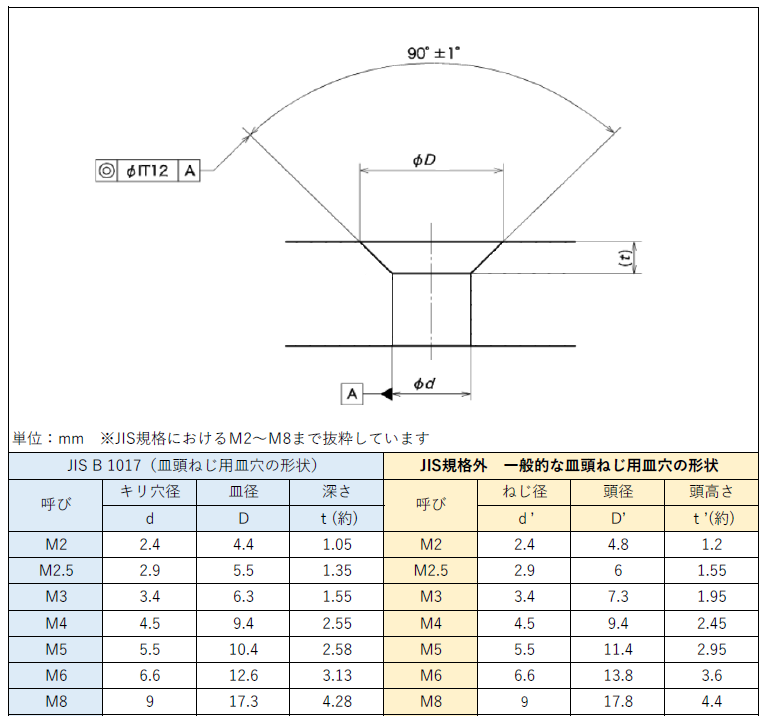
The following figure shows a combination of the holes specified in the JIS standard and the commonly sold "countersunk small screws with cross holes," which is actually a combination of the holes specified in the JIS standard.If JIS standard countersunk hole dimensions are used, the screws will pop out.
*Fine dimensions of screw heads may differ from manufacturer to manufacturer.Therefore, not all of them may exactly match the figure below. (Therefore, please check them only as a reference.)

Like this,With JIS standard countersunk hole dimensions, there is a difference in countersunk screw protrusion.The following is a summary of the results of the study.
Using the commonly used dish fir dimensions will not pop out 👈Use this!
Next, the commonly used reference dish fir and dish counterbore dimensions are shown in the figure.
Basically, use this.
The hole dimensions used in the figure below are the ones I often use. (reference(This is what happens when this countersunk hole is combined with a common "countersunk small screw with a cross-hole.
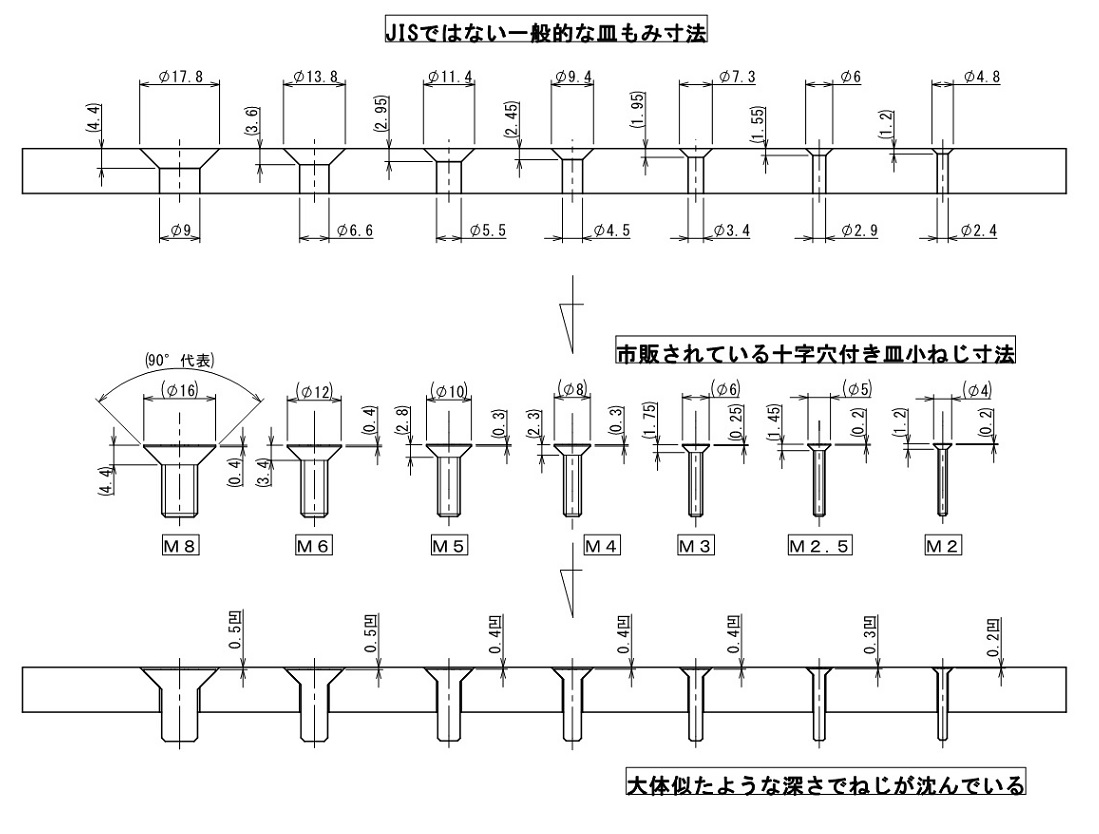
Everything is sunk in and no countersunk screws pop out. This is safe.
This is what happens when a hexagon socket countersunk bolt is inserted
Finally, a diagram with a hexagon socket countersunk bolt in the general countersunk hole dimensions is shown below.
Earlier, I summarized the applicable standards for countersunk holes, but the standards for hexagon socket countersunk bolts were not included there. In some places in mechanical systems, hexagon socket countersunk bolts are used instead of cross-hole countersunk bolts, so this is for that purpose of understanding.
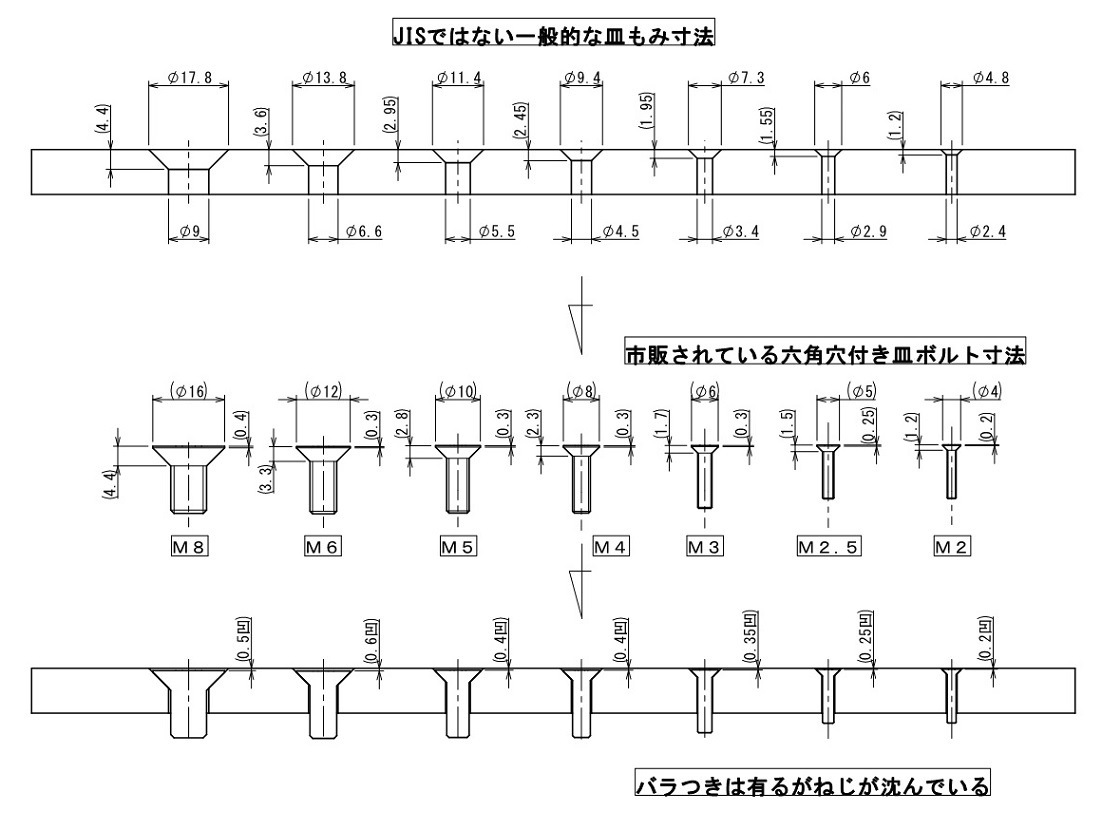
I can use it without any problem.
summary
The table below shows JIS standards and common sizes.
Supplemental information: Points to keep in mind when indicating the firings and countertops on the drawings.
In drilling holes for countersunk screws, when holes are drilled according to JIS standards, general countersunk screws will pop out, but when they are drilled to general countersunk fir dimensions, they will not pop out. Looking at drills for drilling countersunk holes, we found that the dimensions of drills for countersunk screws are not the same for each company.
What should we, the designers, do?
We have received information from all of you, so let me summarize it in bullet points.
processor
- Sinking milling for countersunk screws with drill is not used.
- A dedicated blade can only do so much, and it can only produce a fixed dimension, so we use a flexible processing method that does not care about the outside diameter of the countersunk hole.
- M how many countersunk screw holes machining, just follow the instructions on how many to sink.
- When there is no tolerance, it is like "OK" if a countersunk screw is inserted after machining with a chamfering cutter or a 2.5d cutter.
- It's easy to go as long as it says "head down" and "if it doesn't pop out, it's OK".
- I also sharpen a black drill of the indicated diameter to 90°.
- Basic spot drilling is used to prevent popping out.
- Black skin and other unprocessed materials are not flat, so if they are processed according to dimensional instructions, the depth will vary.
- The plate buckling is a simple process, but it is one of the most tedious of the simple.
- Maybe a note instead of dimensions would be better.
Designer.
- Ignore the depth of the dish counterbore area if it is not necessary.
- When making notes, for M4, use "4.5 kiri-tsushi-shi φ9.5 countersunk counterbore" or something similar.
- The screws for installation are to be supplied in kind as samples for actual matching.
That's it.
For one-off requests, use the notes, and for mass production requests, include the dimensions of the firings and counterbores in the drawings.
That's it.