Here."Basic selection and use of solenoid valves."notes.
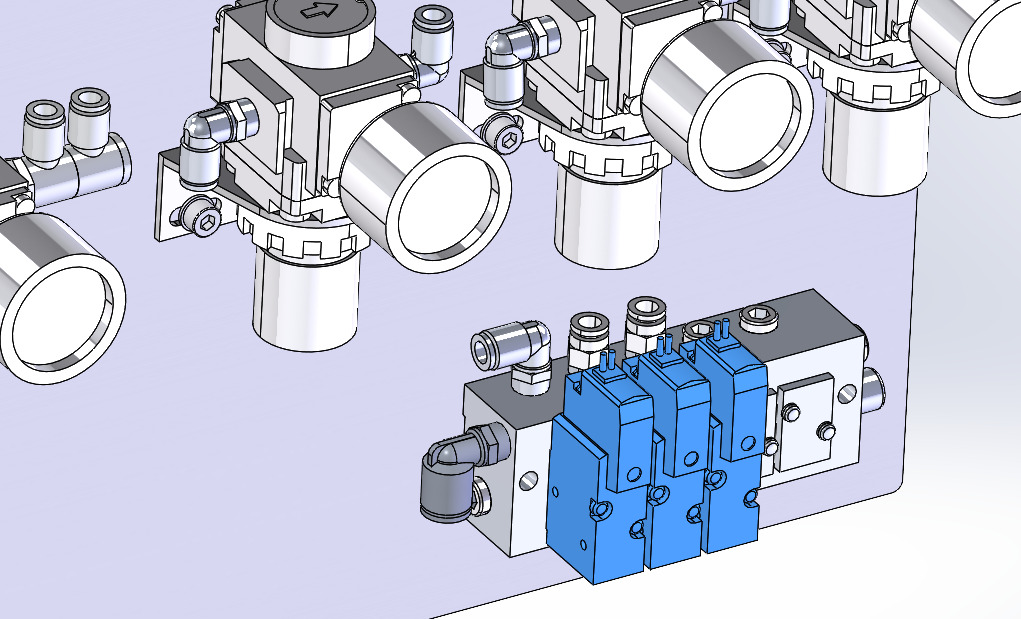
- Selection of solenoid valves
- Difficulty in selecting solenoid valves
- Solenoid valve terms and meanings you should know
- Difference between 2-port, 3-port, 4-port, and 5-port
- Port symbol "P,A,B,R" Meaning
- Difference between 2-position and 3-position
- Difference between direct-acting and pilot-acting
- About Single and Double Solenoids
- Difference between "N.O." and "N.C.
- Difference between direct piping and base piping
- Difference between elastic seals and metal seals, which is more important than it may seem.
- Narrow down the range based on the air cylinder to be used and the planned drive speed.
- The selection of the mechanism is now complete, and the seasoning part is to follow.
- Finally.
Selection of solenoid valves
Difficulty in selecting solenoid valves
First of all, first of all, a general interpretation of solenoid valves, to be clear.
There are so many different types of solenoid valves it's hard to know which one is the answer."
I myself often panic because each customer has its own requirements, such as matching the manufacturer used as a standard product, and the way to use each piece of equipment changes.Generally, solenoid valve selection procedures of many manufacturers narrow down their products based on "required flow rate". Well, for manufacturers of solenoid valves, there are customers who use solenoid valves in various ways, so solenoid valves with special characteristics are developed, and as a result, the catalogs become thicker, just like the current one.
And it's getting harder and harder to look at catalogs, and selection is not easy.
The selection of solenoid valves is, by analogy, like that of an automobile.
There is a car as a means of transportation, and although there is nothing wrong with a mini-car, a regular car is easier to drive long distances and more stable, so the basic selection is "a regular car is the way to go", and among these, Toyota is stable and less prone to breakdowns, but the one that offers interesting cars is Nissan. .....................,
In short,If you don't know everything about solenoid valves, you can't select the solenoid valve you really want.(The car analogy is just one example.)
Well,
I'm going to cut to the chase because I'm going to talk forever about how difficult it is to select forever, but today I'm going to try to note the basics of selection so that you can find a basic solenoid valve anyway.For details (seasoning section), please contact each manufacturer used.
Solenoid valve terms and meanings you should know
As I mentioned earlier, many manufacturers generally narrow down their products based on "required flow rate".But before we get into that, there is something you should know. That is the meaning of the unintelligible terms that come up when selecting a solenoid valve.
It is not necessary to know everything about what they represent, but if you don't know them, you will often have problems when you start the selection process from the required flow rate.Therefore, we have first summarized here the contents necessary for basic selection of solenoid valves.
Difference between 2-port, 3-port, 4-port, and 5-port
When selecting a solenoid valve, open a catalog and you will seeKey words like "3-port" or "5-port." This is the number of ports for air to enter and exit the solenoid valve Consider it to be.How many types of these ports are there?
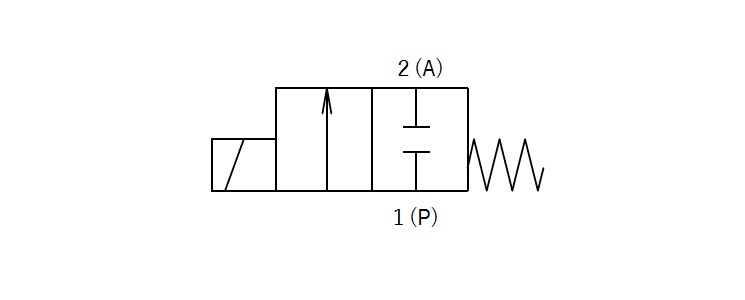
2 ports: 1(P), 2(A)
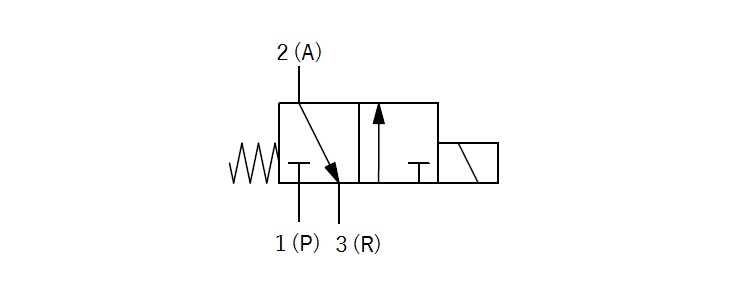
3 ports: 1(P), 2(A), 3(R)
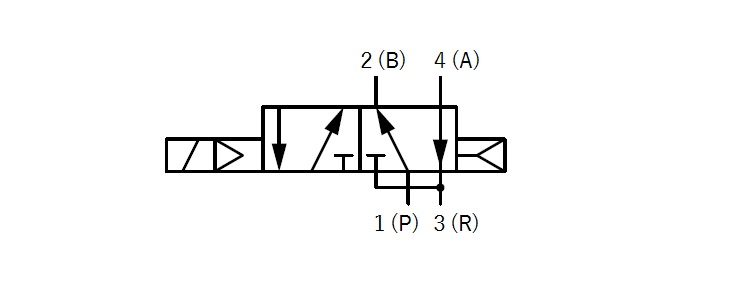
4 ports: 1(P), 2(B), 3(R), 4(A)
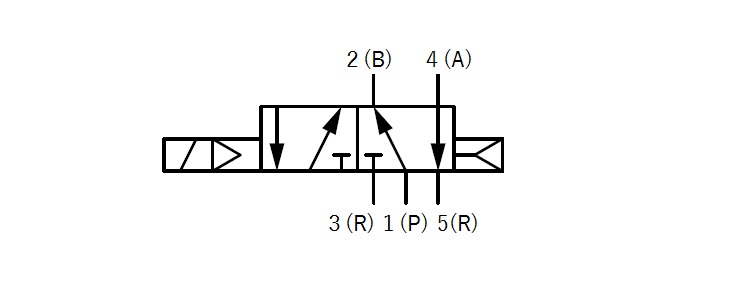
5 ports: 1(P), 2(B), 3(R), 4(A), 5(R)
It is categorized in the above form.
Port symbol "P,A,B,R" Meaning
Written next to the port number above is the port symbol of the solenoid valve.Most manufacturers use the same notation up to P, A, and B, but after that, each manufacturer uses different letters, so it is better to understand them by their contents.
P: Primary supply
R: Discharge
A: (when ON, from solenoid valve) Supply
B: (When ON, return to solenoid valve)
and so on.
Difference between 2-position and 3-position
The port number (port symbol) is,There is also a relationship between the 2-position and 3-position solenoid valves: 2-position and 3-position are, as the term implies, the difference between 2 and 3 positions in which the solenoid valve operates. will be.
Two typical positions are as follows
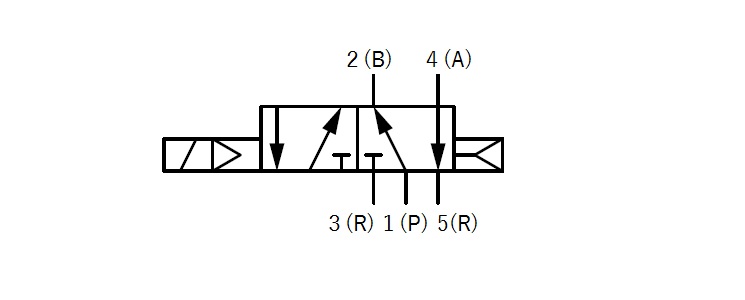
The three typical positions are as follows
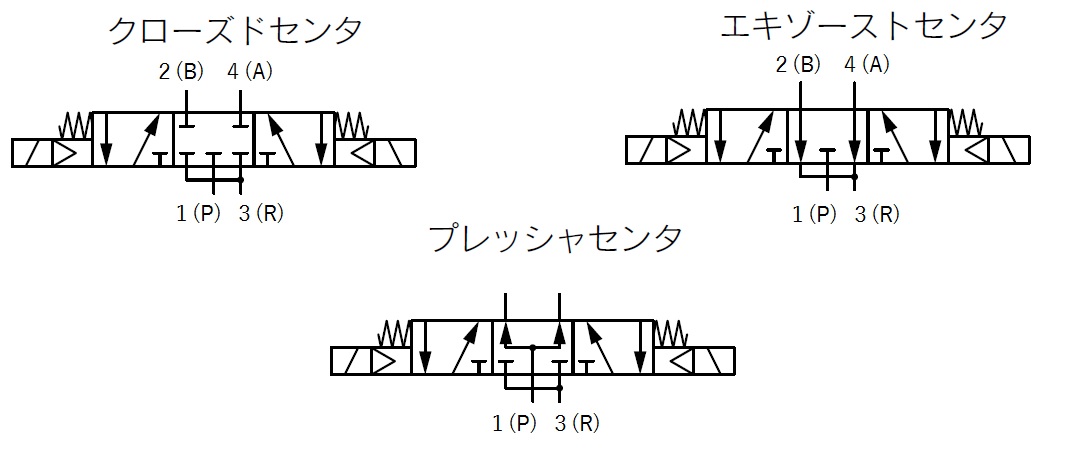
I'm sure you can understand this if you compare it to the port symbols I mentioned earlier,1(P) The key point is that the destination of the supply and the outlet of the exhaust air change depending on the operation (position) of the solenoid valve. It is.
This is then switched by electric current with a solenoid valve. The contents of the solenoid valve are important to ensure that the cylinder used in the machine operates as expected.
Supplement: What are closed centers and exhaust centers?
Closed center
Ports A and B are closed when the valve is de-energized,Used for simple interim shutdown during power outagesWhen restarting, the valve is driven by a solenoid.Exhaust center
Ports A and B become exhaust when the valve is de-energized, allowing the cylinder to be moved by hand,Used for emergency stop, etc.When restarting, the valve is driven by a solenoid.
Difference between direct-acting and pilot-acting
There are two main types of solenoid valve operation methods. Direct-acting solenoid valves are those that mechanically open and close the main passage by means of a movable core inside the solenoid valve. This is also called a solenoid valve.
Solenoid valve = direct acting."Yes.
A pilot operated solenoid valve is a type of solenoid valve that is driven by a fluid pressure difference such as air. There are two types of pilot operated solenoid valves: internally piloted and externally piloted.
About Single and Double Solenoids
This section describes how to distinguish between a two-position single solenoid and a double solenoid and how to use them.
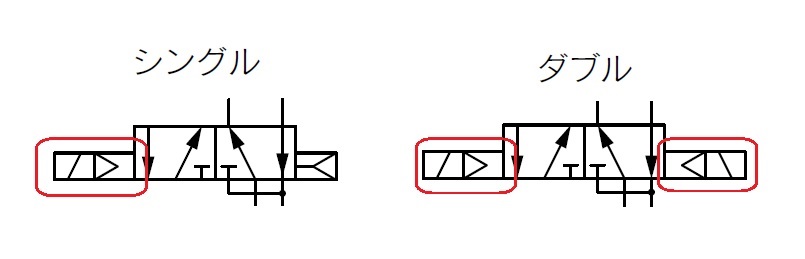
As you may already know since "solenoid valve = direct-acting type," in the case of a single solenoid, an electric current is applied to drive the solenoid when it is moved to one side. In the case of a double solenoid, both solenoids are attached to each other, and each solenoid is driven separately when it needs to be moved.
Single solenoids are characterized by the fact that when one of them is driven and the current is cut off, it returns to its original position. In contrast, a double solenoid remains switched to that position.
In 3-position, there is a solenoid valve called "3-position exhaust center", for example,
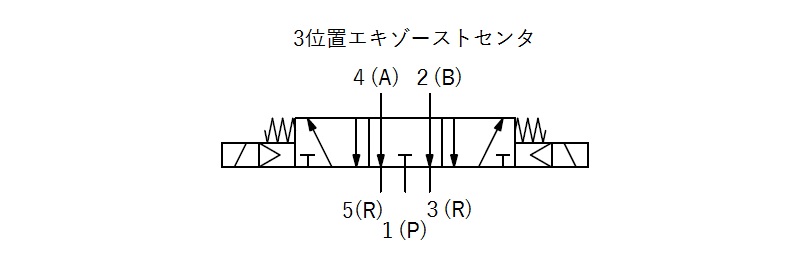
Driven by solenoids at both ends, but returns to center when turned off (de-energized) The use of the product must be matched to the application.
Difference between "N.O." and "N.C.
Now, coming next,You may have understood that there are 2-position and 3-position solenoids, and that they can be driven by either a single solenoid or a double solenoid.
There is one more point of selection.
That is, "what position are they in before they operate? If you look at a solenoid valve catalog, you will see descriptions such as "N.C valve" or "N.O valve," or descriptions such as "normally closed" or "normally open. This indicates the initial state of the solenoid valve (before the solenoid is activated).
Double solenoids, for example, have the feature of holding their position, but single solenoids return to their original position when the current is cut off.
Difference between direct piping and base piping
Now, we are at the midpoint of the selection process.
Solenoid valves are really... hard to select..."
Direct piping and base piping are, as the name suggests, direct piping is a type in which ports are provided on the body of the solenoid valve and piped directly to the solenoid valve. Base piping is a type of set product in which a "solenoid valve without a port" is attached to a base called a "manifold" or "subplate.
*Some cassette type solenoid valves are direct piping type with an open air passage that serves as a manifold. This type of valve is convenient because it does not have a manifold and can be used in narrow spaces or low locations, or when the number of valves can be increased.
Difference between elastic seals and metal seals, which is more important than it may seem.
The keywords "elastic" and "metal" seal appear in the selection of solenoid valves. Elastic valves use packing, which reduces air leakage, while metal valves have a longer service life. It is a good idea to choose according to the application.
Narrow down the range based on the air cylinder to be used and the planned drive speed.
Finally, we have come to this point. Here comes step #1 of the selection procedure provided by the general manufacturer. LOL.
The selection process here is to "select a solenoid valve that can supply air in time" when the air cylinder to be used is operated at the planned drive speed.The "solenoid valve that can meet the scheduled speed and supply" must consider two factors at the same time.
The reason,
For example, if a 25 mm dia. cylinder is used at 100 mm/s or less, the solenoid valve "A" may satisfy the requirement, but not at 300 mm/s. The supply cannot keep up with the speed of the cylinder.Conversely, if the solenoid valve A is used and the size of the air cylinder is increased, the drive speed can be adjusted to slow down to satisfy the supply.・・・・ Do you understand what I'm saying...?
Considering the possibility of subsequent design changes and capacity increases, the solenoid valve must also have a supply volume with a margin of safety.
The selection of the mechanism is now complete, and the seasoning part is to follow.
Well...thank you very much for your long time cooperation.
You have now reached the point where you can find a solenoid valve that meets your flow rate requirements by selecting the above items, how to use the valve, and how to install the valve.
Solenoid valves are one of the mechanisms in the design process, so the machine will work as long as the solenoid valves are used and work accordingly. However, the seasoning part is also important.What kind of seasoning parts are available, for example, solenoid valves that can enter the communication network environment.
There are many things to consider here as well. However, this is not a decision that can be made by the designer alone; it must be made while listening to the opinions of the customer, electricians, and others. This is how the solenoid valve is finally decided. (Selection is a difficult process every time. ・・・・)
Finally.
In this article, we have summarized the differences to facilitate the selection of solenoid valves, and finally, we would like to introduce one useful item.
For example, if there are two sets of cylinders driven by a pair of 3-port solenoid valves, it would normally be "two sets of one 3-port solenoid valve + one cylinder",If you use a dual 3-port solenoid valve, you can use "1 dual 3-port solenoid valve + 2 cylinders", so please select the solenoid valve that each manufacturer has in their main features.
That's it.
-

-
The Complete Guide to Air Circuit Design|Thorough explanation from basics to practice
Here we note "A Complete Guide to Air Circuit Design, from Basics to Practice." Air circuit design is one of the most important skills for mechanical designers. In practice, however, it is not always easy to design to a schematic ...
See more.
