Today, we are going to discuss the "Information on general counterbore depths (dimensions) and processing methods for hexagon socket head boltsHere is a note about "The
I've already found a lot of this kind of dimensional information on the web,This article is for "those looking for general counterbored dimensions and JIS standards for hexagon socket head bolts."This article is written for the following. We have also compiled some information on machining methods for counterbore dimensions, so if you are a designer and are interested, please feel free to check it out.
Hexagon socket bolt counterbore dimensions
What are the general counterbore dimensions of a hexagon socket head bolt?
Here,Counterbore dimensions for hexagon socket head bolts published by commonly used MISUMI and pot shopsThe following is a summary of the following information.
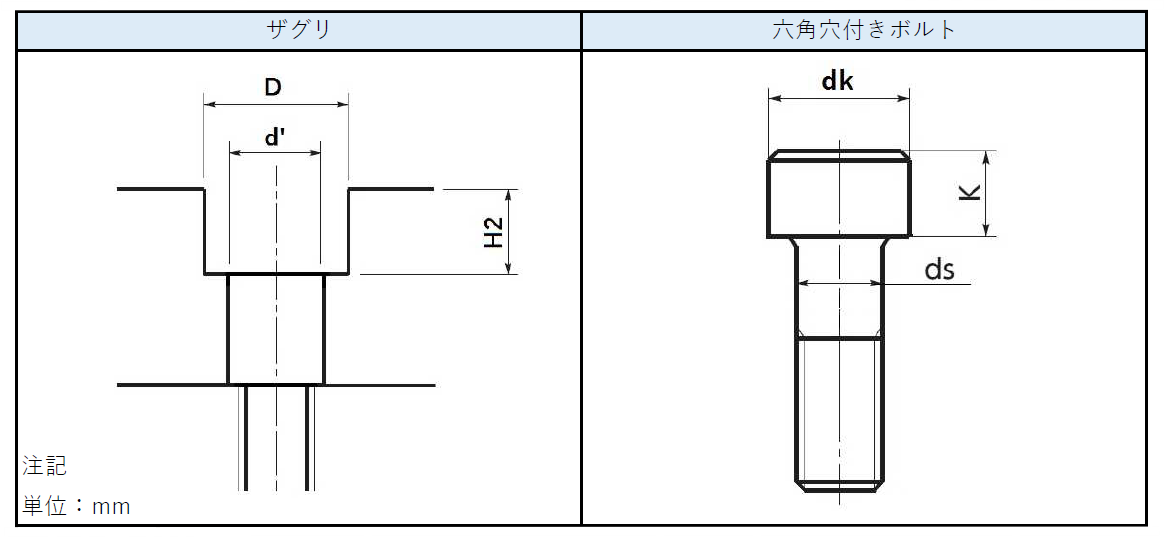
| board game of capturing territory | Hex Socket Head cap Bolt | ||||||
|---|---|---|---|---|---|---|---|
| call | clearance hole (hole for a bolt, screw, etc.) (d’) |
Counterbore (D) |
depth (H2) |
call | Screw diameter (ds) |
Head diameter (standard value) (dk) |
Head height (max.) (K) |
| M1.6 | 1.8 | 4 | 1.6 | M1.6 | 1.6 | 3 | 1.6 |
| M2.5 | 2.9 | 5.5 | 2.5 | M2.5 | 2.5 | 4.5 | 2.5 |
| M3 | 3.4 | 6.5 | 3.3 | M3 | 3 | 5.5 | 3 |
| M4 | 4.5 | 8 | 4.4 | M4 | 4 | 7 | 4 |
| M5 | 5.5 | 9.5 | 5.4 | M5 | 5 | 8.5 | 5 |
| M6 | 6.6 | 11 | 6.5 | M6 | 6 | 10 | 6 |
| M8 | 9 | 14 | 8.6 | M8 | 8 | 13 | 8 |
| M10 | 11 | 17.5 | 10.8 | M10 | 10 | 16 | 10 |
| M12 | 13.5(14) | 20 | 13 | M12 | 12 | 18 | 12 |
| M14 | 15.5(16) | 23 | 15.2 | M14 | 14 | 21 | 14 |
| M16 | 17.5(18) | 26 | 17.5 | M16 | 16 | 24 | 16 |
| M18 | 20 | 29 | 19.5 | M18 | 18 | 27 | 18 |
| M20 | 22 | 32 | 21.5 | M20 | 20 | 30 | 20 |
| M22 | 24 | 35 | 23.5 | M22 | 22 | 33 | 22 |
| M24 | 26 | 39 | 25.5 | M24 | 24 | 36 | 24 |
| M27 | 30 | 43 | 29 | M27 | 27 | 40 | 27 |
| M30 | 33 | 48 | 32 | M30 | 30 | 45 | 30 |
remarks
The drill hole diameter is based on JIS B 1001: Bolt hole diameter and bore diameter (Class 2).
The red figures indicate hole diameters according to MISUMI and Nabeya.
M1.6 and M2.5 are not available from MISUMI and Nabeya, so they are included in the table with reference to Alps Seiko's data.
The above table shows hexagon socket head cap screws and counterbore dimensions separately.I am sure that many of you are designing with these above counterbored dimensions.
As far as I know,At this time, there is no JIS standard for deep counterbored dimensions specifically for hexagon socket head bolts.Therefore, I believe that everyone adopts the above dimensions published as a reference.
I don't know why there are no deep counterbored dimensions specifically for hexagon socket head bolts, but MISUMI and Nabeya also say that the drill hole part (the ’d'" part in the table) isClass 2" of "JIS B 1001: Bolt Hole Diameter and Bore Diameter" is mostly applied.
As for the meaning of "almost applicable," the dimensions in red (M12, 14, 16) in the table are slightly different from "Class 2" in "JIS B 1001: Bolt Hole Diameter and Bore Diameter". I am not sure how to interpret this part, but I think it is fine to use either JIS or MISUMI or pot shop's dimensions.
I confirmed what kind of dawn Zaghari is.
I am sure that counterbored holes are troublesome to drill. I wondered what kind of hole drilling is done for a counterbore..." I checked the catalogs of knife makers and Twitter, which I have been using recently to gather information.
Processing Methods for Zaguri
[I].I have a question.
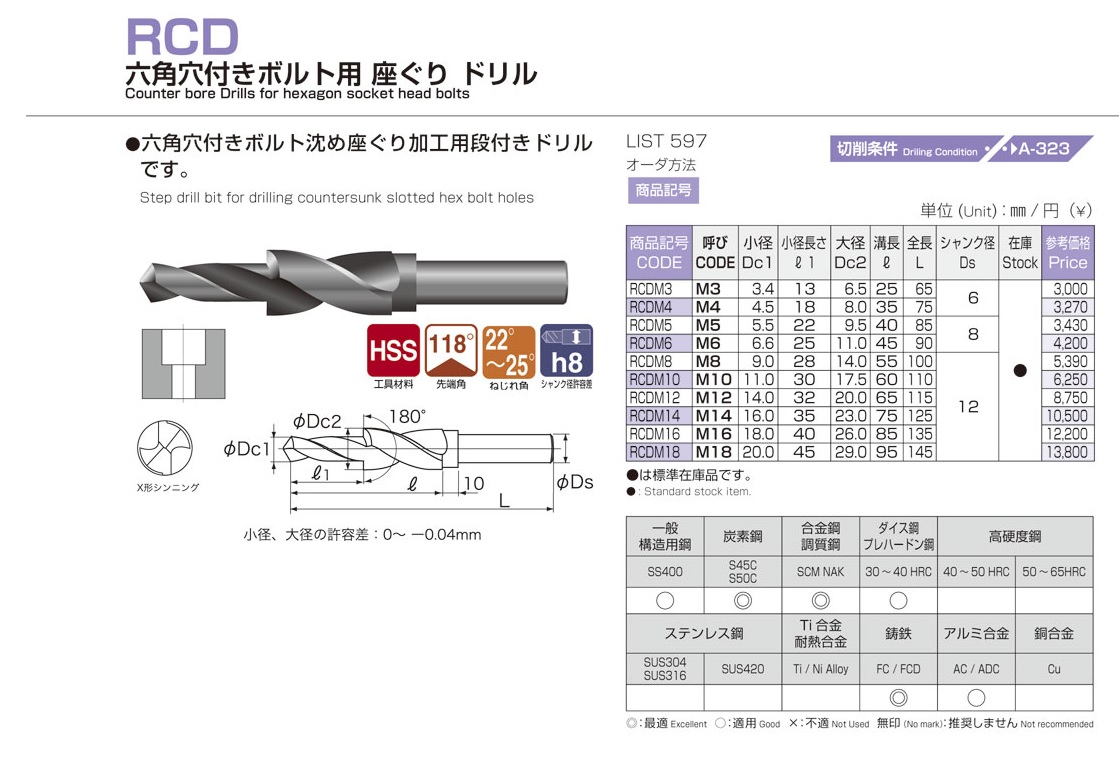
For hexagon socket bolts, do you generally use a step drill (hexagon socket counterbore drill)?
↓↓↓ (Reference: Borrowed from Fujikoshi)
[Mr. K]
We hardly ever use it either.The reason is that there is not much that can be used when trying to process as per the drawings.
【Mr. S]
Old processing shops use it.Most young processors these days don't use it. This is only my perception among my customers.
【Mr. F]
For processing by NC equipmentDrill + endmill is more common now.I think it is.
[M.
I amNormal machining is drill + endmill or endmill only.I think the only time I use a zigzag cutter is when I occasionally use a drilling machine to process waste material. The most common processing options are drilling the specified bolt hole diameter and endmilling the counterbored portion, ramping the entire process with an endmill if the job is done on the side, or using two flat drills if the job is done on the side.
I think the fastest is flat drilling.http://www.nachi-fujikoshi.co.jp/tool/drill/aqua_ex_flat_a.htm
[S.F.
I amYou are using a sinking milling tool (a tool that first drills a through-hole for the cap bolt and then does the seating).The disadvantage is the need to replace the drill.
We have received more than ** information. Thank you very much for your cooperation!
What should we, the designers, do with the counterbored dimensions?
For us designers, it seems safe to use the general counterbore dimensions (MISUMI or pot shop). We do not know if the fabricator uses a "hexagon socket bolt counterbore drill" or not, but the dimensions of a "hexagon socket bolt counterbore drill" are consistent with the reference dimensions of MISUMI and the pot shop.
On the other hand, if the design structure does not allow for general dimensions, or if the end-user's standard deviates from the general dimensions, it is necessary to "state so in the notes". This is because what is common in one place may become special in another place.
That's it.