WHEREAS.mechanical drawing One of the notes in the "one of the notes in theGeneral interpretation of thread chamfer and guide dimensionsI would like to make a note about the following. This is a slightly more detailed explanation so that even beginners in mechanical design can easily understand it.
light chamfering (engineering)
Look closely at the drawing's instructions.「Corners must be thread chamfered unless otherwise indicated.」。
This Ito-men-tori (thread chamfering) is the same as C-chamfering and R-chamfering.Indicates the shape of the corner of the part.and means a smaller chamfer than C chamfer and R chamfer, and I think we often use the instruction for thread chamfer mainly for the purpose of removing burrs (to prevent injury).
The advantages of using thread chamfering instructions include,Advantages such as reduced man-hours instead of not specifying the chamfer amountThere are
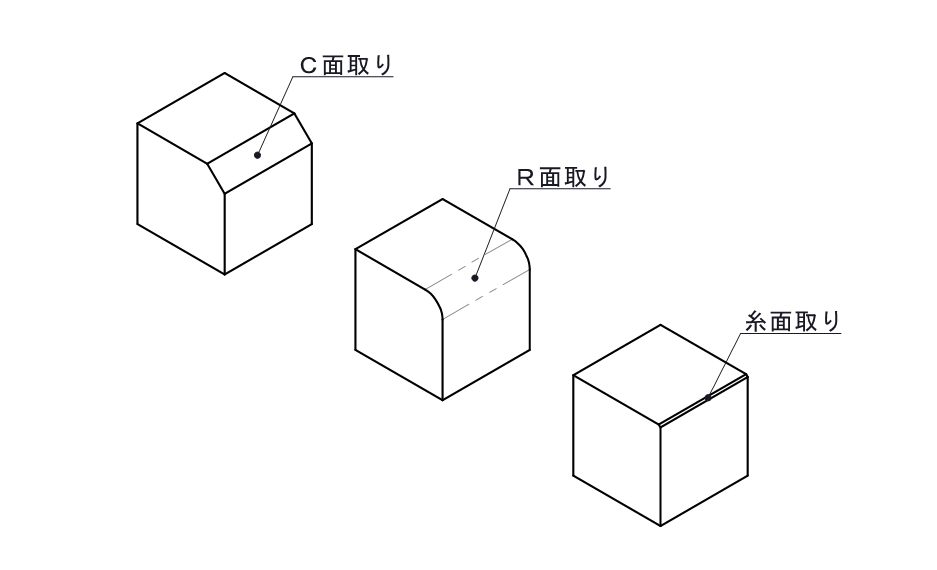
- C chamfer: structurally necessary chamfer, protective chamfer
- R chamfer: structurally necessary chamfer, protective chamfer
- Thread chamfering: Protective chamfering (filing)
However, thisThread chamfering varies from C0.1 to 0.5 mm depending on the size, category and manufacturer of the parts handledIt is.Among the more common interpretations, many will respond that the more common interpretation is about C0.2 to 0.3.
It seems that the burrs removed at C0.2-0.3 were called thread chamfering because they are thread-like. In fact, at C0.2-0.3, the possibility of cutting a finger is almost eliminated.But why is the misrecognition of thread chamfering dimensions happening?Numerical range for "thread chamfering" is not defined by JIS.From.
JIS standard
- JISB0051 Drafting - Edges of parts - Terms and methods of indication
- JISB0721 Edge quality of machined parts and their grades
Then,The term "thread chamfer" does not exist,
- JISB0090-1 states "Thread chamfering is protective chamfering.
- JISC7709-0 states "Thread chamfering is a fine chamfer."
It is only stated that the
Surprising, isn't it? Because of the ambiguity of this thread chamfer, there are places where the range of dimensions is determined by an agreement between design and manufacturing, but notGenerally, thread chamfer is about C0.2 to 0.3 for protective and fine chamfers when thread chamfering is indicatedIt is conveyed as
In transactions where there is no agreement, we sometimes receive inquiries such as "What are the dimensions of the thread chamfer?Areas that are likely to cause problems.It might also be a good idea to understand that this is not the case.
Conclusion.
Thus, since thread chamfer is an ambiguous expression, the designer cannot blame the machinist even if it is different from what he expected, since the object will come up with a C0.1 to 0.5 depending on the item when thread chamfer is indicated.If you do not like that, it is better to specify the amount of chamfer at the corners.
Especially like mass production.If you want to stabilize the shape, you should specify the chamfer amount numerically.and with respect to one-off components.「Corners without indication are to be thread chamfered (C0.1 to C0.3)」This is a method of describing notes so that the amount of chamfer is somewhat general, such as
That's it.
-

-
Introduction to Mechanical Drawing
Here, I would like to leave a note as an introduction to mechanical drawing, "Thorough Explanation from Basic Rules to Drawing Methods". In mechanical drafting, I have been wondering if I can really convey the ...
See more.
