Today, we are going to discuss the "Meaning, reading and conversion of inch dimensionsThis is a memo about "The Japanese version of the Japanese version of the American version of the Japanese version of the American product. In mechanical design, there are jobs in which we purchase and use American-made products or replace American equipment drawings with Japanese versions and rebuild or modify the equipment according to the customer's specifications.
If you are accustomed to Japanese drawings, you will seeInch dimensions are indicated with seemingly unintelligible dimensions.We will note those basics, as they require a slightly different interpretation when reading those inch dimensions.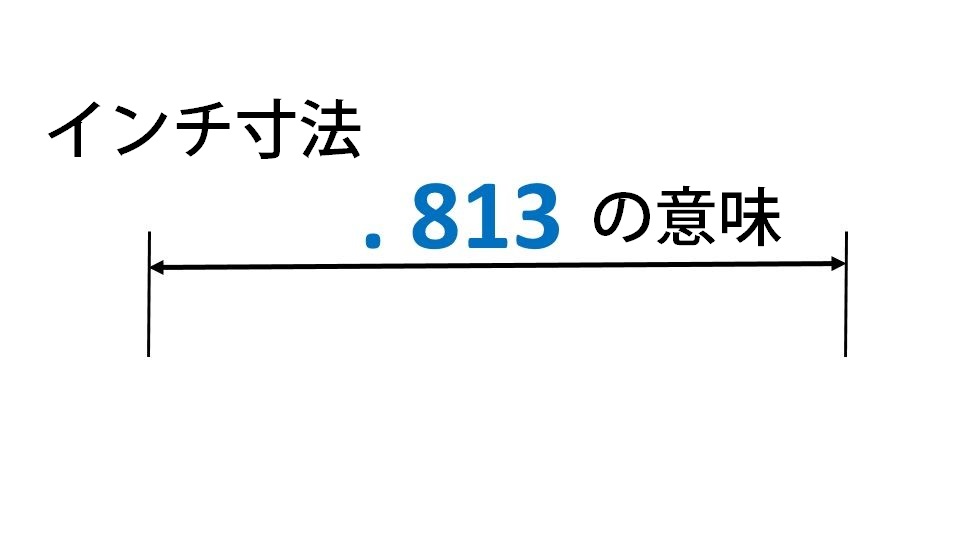
- What are inch dimensions?
- In the drawings, there are dimensions such as ".813" that are not legible.
- Rule 1: Decimal points such as ".813″ should be listed to three places.
- Rule 2: When converted to millimeters, such as ".813″, the decimal point should be listed to two places.
- Rule 3: Fractions in inches are displayed to one decimal place when converted to millimeters.
- Note: "′" is in feet, not inches.
What are inch dimensions?
The inches areUnit of length in the yard-pound system, 1 inch is 25.4 mmis "in". Basically, the symbol is defined as "in" in both ISO and JIS,Double prime symbol "″"It may also be represented by
Example of reading: 5″ = five inches.
In the drawings, there are dimensions such as ".813" that are not legible.
One inch is 25.4 mm, and allIf 25.4 is divisible by 25.4, the expression is "3/4in = 19.05mm", etc.
Typical value in inches
- 3/4in = 19.05mm
- 5/8in = 15.875mm
- 1/2in = 12.7mm
- 3/8in = 9.525mm
- 1/4in = 31.75mm
- 1/16in=1.5875mm
However,The above detailed dimensional values that cannot be expressed in numerical values are used in the dimensions of drawings using ". ← point" is used in the drawing dimensions.For example, ".813".
Example 1: .813 = 20.6502 mm. ConversionThe formula is "0.813in x 25.4mm = 20.6502mm.
Example 2: 12.523 = 318.0842 mm. ConversionThe formula is "12.523in x 25.4mm = 318.0842mm".
As of 0.813in.Omit the "0 zero" where the dimensional value of less than 1″ (1 inch) would be "0.813″.
Rule 1: Decimal points such as ".813″ should be listed to three places.
When calling out inches, list to three decimal places.(I assume this is the case unless there is a very special exception)
Rule 2: When converted to millimeters, such as ".813″, the decimal point should be listed to two places.
When converting inch designations to millimeters, decimal points should be listed to two places.
So, the value converted above
Example 1: .813 = 20.6502 mmis 0.813in x 25.4mm = 20.65 (indicated value)
Example 2: 12.523 = 318.0842 mm is,12.523in x 25.4mm = 318.08 (indicated value)
Rule 3: Fractions in inches are displayed to one decimal place when converted to millimeters.
This is a drawing rule, or as far as I know, a rule of representation,Inch on fractional display has one decimal place when converted to millimeters.
So "3/4in = 19.05mm" is "3/4in = 19.1mm".
Note: "′" is in feet, not inches.
People often misunderstand "5′" as "inches," but it means "5 feet.The feet are "′ (prime symbol)". Please be careful.
That's it.
-

-
Basic calculations
This section contains notes on the basic calculations for mechanical design that I use in my practice. The articles with calculations and the calculations are revised as needed, so please use the latest version when using them. If you have any questions, please feel free to contact me.
See more.