Hello, equipment designer for pharmaceutical and food productsdrafterMy name is
Pharmaceuticals and food products are manufactured in clean rooms, where foreign substances are removed and the air is highly purified, because contamination with foreign substances can affect the human body.
Similarly, factories that manufacture semiconductors, flat panel displays (FPDs), and electronic components produce in clean rooms because even foreign particles as small as a few micrometers can affect quality.
When designing machines for clean rooms, which are extremely averse to foreign matter, there are some things that need not be considered during normal machine design. So, in this article, I will note three key design points for designers of equipment that operates in cleanrooms.
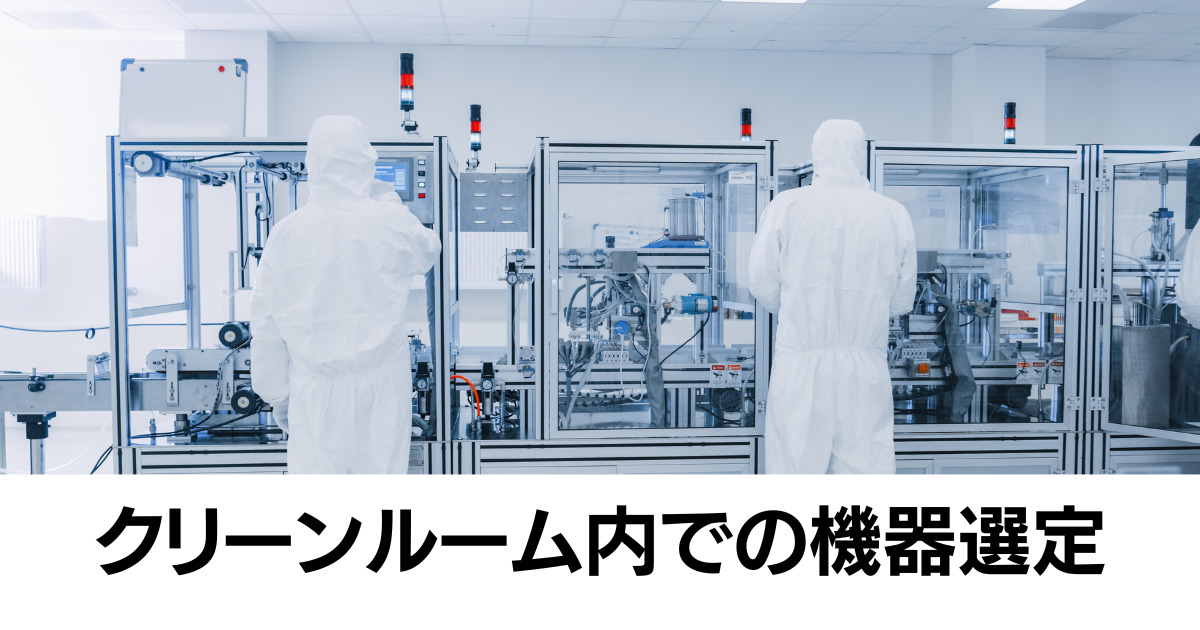
- Machine design in clean room
- (1) First, determine the cleanliness of the environment where the machine will be used.
- (2) Be careful of adhesion of sliding parts in the machine to the product due to dust generation.
- (iii) Check the dust emission and safety of lubricants.
- (4) Select highly corrosive materials (stainless steel is preferred) for exposed areas and product contact areas.
- Finally.
Machine design in clean room
(1) First, determine the cleanliness of the environment where the machine will be used.
When designing a machine to be used in a clean room, the first step is to determine the level of cleanliness of the site.
Cleanliness refers to the cleanliness of the air in a clean room and is defined by ISO and JIS.
This article refers to cleanliness as cleanliness.
ISO standard for particles 0.1 µm or greater in air per m3 The ISO Classification System (ISO Class 1-9) is used to classify the classes. However, in some cases, the U.S. Federal Standard, which has been widely used in the industry for some time, is used.
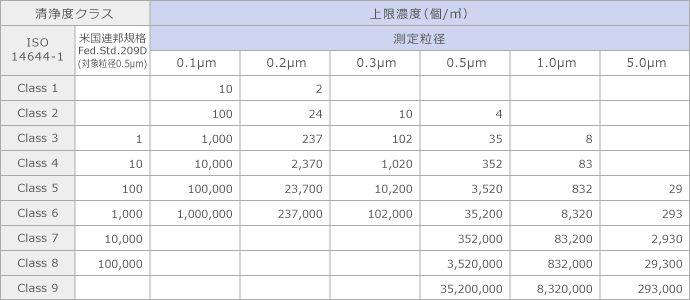
This cleanliness class is,The lower the value, the higher the cleanliness, and the higher the cleanliness, the less likely dust will affect the product, but the higher the operating cost. It is.
Approximate cleanliness (in order of highest to lowest)
Semiconductor plants: Class 3~5
Electronic components and precision equipment factories: Class 5~7
Pharmaceutical and food factories: Class 5~8
Auto parts factories and operating rooms: Class 6~8
For the cleanliness level at the location where the machine will be installed, inquire at the quality control department of the company's factory or check the product specifications or other instructions for manufacturing the product.
If you are installing the equipment at the customer's factory as a supplier (supplier/supplier), the specifications will probably include an arrangement for the installation.
(2) Be careful of adhesion of sliding parts in the machine to the product due to dust generation.
Products (workpieces) manufactured in clean rooms are not allowed to contain foreign matter.
The main causes of foreign matter such as dust and dirt (collectively called "dust") are the above-mentioned human activities and machine operations. It is.
Since clothing fibers and human sweat are also foreign substances, workers wear clean clothes instead of normal work clothes. Similarly, machines must be free of foreign substances, or if they are, they must not be mixed with products by collecting dust or covering them.
Dust from machinery is mainly generated in sliding parts, especially from gaskets. The packing is a metal packing. The sliding of the packing against the metal causes dust to be generated from the packing powder. There are various packing materials, but nitrile rubber (NBR) and urethane rubber are generally used.
A typical example of this is the air cylinder It is.
In air cylinders, the rod section moves back and forth at high speed under the force of air, and packing is used to prevent the air from leaking.If the air cylinder moves at a high frequency, a huge amount of dust is generated. I will do so.

An example of this measure isUse of low-dust air cylinders that can be used in clean rooms and more frequent replacement of packing parts are effective. It is.
In addition to air cylinders, rotary actuators, bearings, timing belts, and other sliding and meshing parts will always generate dust, so it is necessary to take countermeasures.
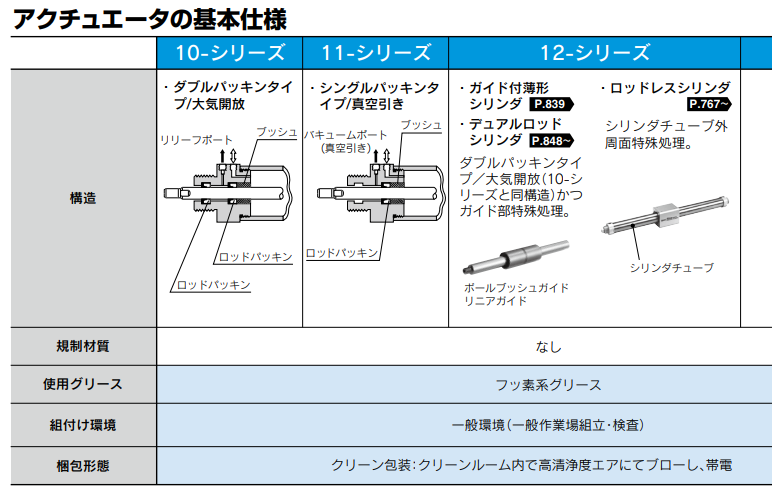
The easiest solution is to use clean room-compatible products, but this increases costs and procurement lead times.
To add to this placement of equipment below the workpiece, clean rooms are usually built with the concept of downflow, in which air blows from the ceiling side to the ground and there is an intake on the ground side to capture foreign matter. ThereforeIf air cylinders and other equipment are installed lower than the product, the possibility of foreign objects coming into contact with the product can be minimized.
(iii) Check the dust emission and safety of lubricants.
When selecting a lubricant (grease), choose one with low dust emission.
Dust emission from oil? Some people may think thatWhen oil is working as a lubricant in sliding parts, the oil changes from a liquid to a gas and can be dispersed as gas (suspended particles).
This adheres to equipment, people, and products and diffuses. For this reason, lubricating grease for clean rooms that does not evaporate (vaporize) easily is applied and used.
Also, when applying the grease, a generous amount will cause the grease to run out, so the application should be kept to a minimum and the product should be operated for several minutes to several tens of minutes without running during initial operation to check for grease run out before starting production.
Lubricants for food machinery are sometimes required in pharmaceutical and food manufacturing sites, although they are not considered important in the semiconductor and electronic component industries.
Lubricants for food machinery are lubricated with U.S. Food and Drug Administration (FDA) standard ingredients. These lubricants are registered with a U.S. non-profit third-party organization called NSF as lubricants licensed to come in contact with food products.
Lubricants registered with the NSF are subject to the following standards
- H1: Items that should not come into contact with food but are safe to be contaminated
- H2: Absolutely must not come in contact with foodstuffs. However, it can be used inside and around food factories where food is not placed.
- H3: Items used to prevent rusting of hooks used to hang meat in meat plants, etc., and not used for the purpose of coming in contact with food. Soybean oil, etc., which is safe to eat.
- 3H: Vegetable oil used to prevent burning on grills, frying pans, etc., and used for the purpose of direct contact with food.
For lubricants that may come in contact with food, it is safer to choose H1 certified lubricants.
Aside (Part 1)
An international method of sanitation control is HACCP (HACCP).HACCP is a term coined from the initial letters of "Hazard, Analysis, Critical, Control, Point" and is a management method for sanitation control. It is.
In Japan, the introduction and operation of HACCP has become fully mandatory from June 2021 for all businesses that handle food products.
In HACCP, the use of lubricants is considered in the following order of priority
- No lubricant
- Take measures to prevent lubricant from leaking or touching
- Use lubricants that allow incidental contact with food
If there is a better method that does not require the use of lubricants, we will choose that method. Even if H1 certification is obtained, if the lubricant gets mixed in with chemicals or food, it could cause a problem and, in the worst case, result in a voluntary recall of the product.
(4) Select highly corrosive materials (stainless steel is preferred) for exposed areas and product contact areas.
The choice of component material in a clean room is also important.
In principle, stainless steel is used for exposed areas and product contact areas. The reason for using stainless steel is that it is highly corrosive and rust-resistant.
Rust is a major enemy in clean rooms, and once it occurs, it spreads, and over time it can crumble and spread, adhering to products.
Therefore, use stainless steel or aluminum with surface treatment such as anodizing to prevent rust from occurring. However, because the surface treatment may peel off, some factories may specify that the exterior parts must be made of SUS304.
The number of cases specifying SUS316, which has higher corrosion resistance than SUS304, has been increasing recently, especially among overseas customers, and there is a movement to unify the use of SUS316 for machines shipped overseas.
However, SUS316 has poor workability and is expensive, so the merits and demerits of using it should be fully considered at the design stage.
Aside (Part 2)
Some customers ask for a mill sheet to prove the materials used. A mill sheet is a document issued by a steel manufacturer that certifies the quality of steel materials and describes the mechanical properties and chemical composition of steel materials for each production lot. In some cases, customers are suddenly asked to submit a mill sheet at the time of machine shipment or when submitting the as-built drawings, so it is advisable to confirm whether or not a mill sheet is required at the specification meeting stage.
I had assumed that no mill sheet was submitted, but when I witnessed the machine operation, I was told, "Of course you have a mill sheet, don't you? I was once told "Of course you have a mill sheet, don't you?
Finally.
Lastly, we have included search keywords for resources that provide information on equipment used in cleanrooms. *Links may be broken due to site adjustments on the other end.
- SMC,Pneumatic equipment for clean rooms
- Low dust specification pipe fittings for use in SMC and clean rooms
- Special environmental specifications for THK, Linear Motion Systems
- NTN,Bearings for clean environments
- MISUMI,Clean Environment Response
That's it.