Here.The Basics and Concepts of Tolerance Design." I am making a note about the
I have heard it said that tolerance design technology supported Japanese manufacturing.
Recently, though, I have been putting in tolerances with a purpose,When I was a novice designer, I used to follow right behind and quote from past drawings as is. Tolerance has a lot of specific wording,Whether the structural design is good or bad in the first place also affects the tolerance expression, and I think it is really difficult.
Tolerances areIn addition to appropriate wording, it is also important to have a basic idea of why tolerances are necessary in the first place and what happens if they are not included. I believe that this is a good idea, so today I leave you with a note on the basics of tolerance design and the concept.
- What is Tolerance Design?
- Tolerance Basics
- Why do we need tolerances in the first place?
- What types of tolerances are there?
- What is dimensional tolerance?
- What is Geometric Tolerance?
- Can we all design for tolerances?
- What kind of tolerance is to be set at what location?
- Harms of stating tolerances in all
- Conversely, problems that occur when tolerances are not included
- What parts require tolerance design?
- Tolerance Calculation Method
- There are two ways to calculate tolerances
- ① Compatibility method (easy to understand)
- (ii) Incomplete compatibility (a little difficult)
- Understand and practice how to calculate tolerances to get different answers.
- Points to review before relying on tolerances and points that need to be relied on.
- Finally.
What is Tolerance Design?
In order to ensure that the quality meets the requirements of the assembled product, the designer must balance manufacturing cost and quality in terms of dimensional and geometrical tolerances for each part and calculate the tolerances, including statistical considerations.Tolerance design The result of the tolerance design is noted along with the main dimension values in each drawing and communicated to the manufacturer. The results of the tolerance design are noted along with the main dimension values in each drawing and communicated to the manufacturer.
Tolerance Basics
Why do we need tolerances in the first place?
In the manufacturing process, there will always be variations in the dimensions and shape of actual product parts, and these cannot be reduced to zero, which is the reason why tolerances are necessary.In order to meet the required quality, it is necessary to determine the upper and lower limits of tolerance (tolerance range) that allow for variation with respect to the target dimensions.
its tolerance.tolerance It is called.
What types of tolerances are there?
There are two main types of tolerances: dimensional tolerances and geometric tolerances.
What is dimensional tolerance?
Dimensional tolerance is a standard (setting)Indicate acceptable range for dimensions It is.
When the standard (set) dimension is 100 mm
- 100 ±0.1: Indication of desire to have the product manufactured within a range of 0.1 up or down from a dimension of 100.
- 100 +0.1+/-0.1: Indication of desire to have the product manufactured within a range of 0.1 above or below the dimension of 100.
- 100 +0.1/0: Indication of desire to have the product manufactured within an upper limit of 0.1 and a lower limit of 0 for a dimension of 100.
- 100 -0.1/-0.2: Indication of desire to have the product manufactured within the upper limit of -0.1 and the lower limit of -0.2 with respect to dimension 100.
Such as.
What is Geometric Tolerance?
Geometric Tolerance indicates word or phrase being definedUnlike dimensional tolerances, the shape of parallel and perpendicular shapes is regulated within a tolerance range. It is. (Image below)
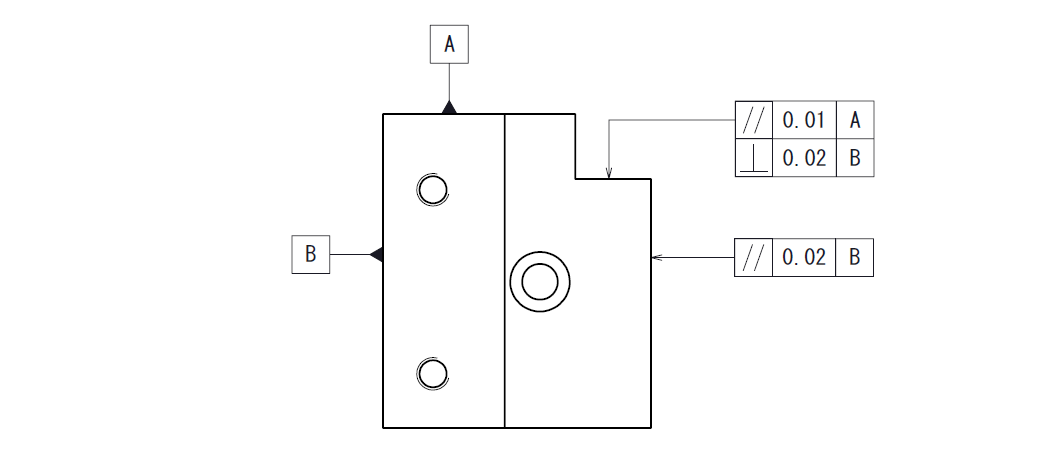
As a way of evaluation,Dimensional tolerances are easy to measure with calipers, micrometers, and other common measuring instruments. However,This geometric tolerance requires the preparation of a measuring instrument capable of measuring each posture.
Can we all design for tolerances?
Let's touch on the practicalities of tolerance design for a moment.As a designer myself, I think there are many designers who are not capable of tolerance design.
Introduction to Tolerance Design There was a survey of 18,000 people in a wide range of industries (2016) in a book called
Citation: Facts about Japan
(1) Tolerance design and analysis implementation status
- Ensured implementation: 2%.
- Occasionally conducted: 20%
- Not implemented: 50%.
- Do not know: 28%
(2) What about geometric tolerances?
- Use: 20%.
- Not used: 80%.
However, this was some time ago, and from around that timeMore people are using it than this because of tolerance design seminars and the development of web information. I think.
Important.Not OK because it is implemented. If the product is not used correctly, each tolerance will affect the product.I have the impression that there are differences in the way tolerances are applied to drawings in different industries.
Some designs are beautifully expressed, while others are misused. In other words, for the machinist, the inclusion of tolerances (in this case, geometric tolerances in particular) can cause the drawing to be misinterpreted and misused.It is also true that parts production is made more difficult. It is.
What kind of tolerance is to be set at what location?
If variation occurs in all parts, then all parts must have dimensional and geometric tolerances.General Toleranceis stipulated,There are two types of dimensional tolerances: general tolerances that are not entered in the drawing for the part in question, and dimensional tolerances that are entered when there is a deviation from the general tolerances.
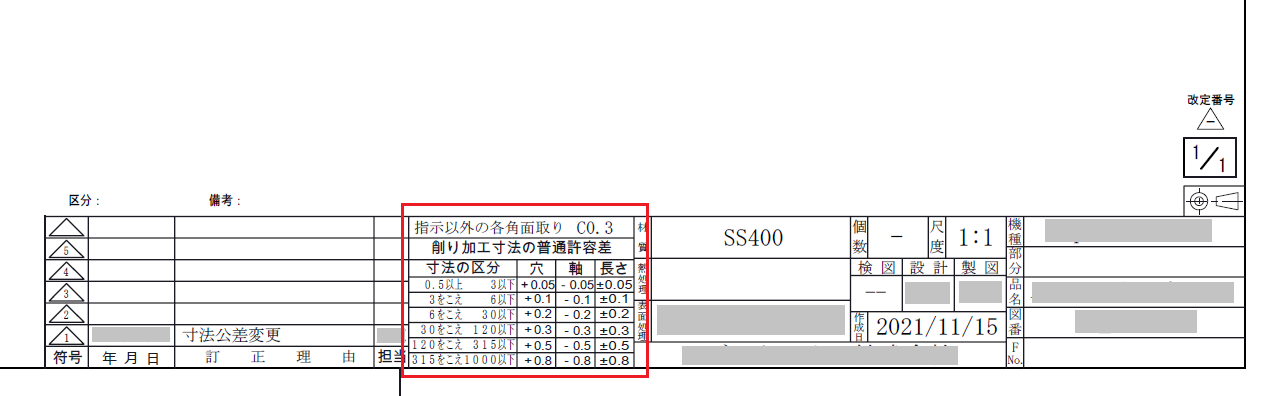
Typical for this entry dimensional tolerance areFit tolerance (fit of parts to each other) and ... andGeneral tolerances directing tools, etc. to enter and apply these according to the situation.
Harms of stating tolerances in all
Tolerances are determined by the designer, but the realization of those tolerances takes place on the manufacturing floor.
For example, if 100±0.1 is compared with 100±0.02, the narrower tolerance is more difficult to achieve in manufacturing, requiring more setups, better jigs, control of machining tools (knives), expensive measuring instruments, and examination of the validity of the measurement method.
Large or tight tolerances = high unit cost per part
This will be the case.
Conversely, problems that occur when tolerances are not included
Tight tolerances increase manufacturing costs, so it is more acceptable to the manufacturing side if the tolerances are as loose as possible.
However, if the tolerances are too loose (larger tolerances), the assembly consisting of those parts will not be assembled properly,The designer must set tolerances that satisfy the desired quality and production cost even if all parts of the assembled product vary within the tolerances allowed.
What parts require tolerance design?
Situations requiring tolerance design include
- Mass production: Tolerance design required
- Single assembly: Tolerance design required if there is an important target value after completion, not required if there is not
- One-off single part: Tolerance design basically unnecessary
In other words, it is correct for a designer to think that tolerance calculations are required for assemblies, although not for all parts.
Tolerance Calculation Method
There are two ways to calculate tolerances
Tolerance calculations requireCompatibility Methods and Incomplete Compatibility Methods There are This article will give a brief example.
① Compatibility method (easy to understand)
Calculation method when all parts are assembled with maximum or minimum tolerance (worst-case accumulation)
(1)-1 Tolerance calculation example:What is the tolerance of B if the target dimension A has a tolerance of ±0.5 and 5 parts are stacked in between?
5B = 0.5
B = ±0.1
(1)-2 Tolerance calculation example:What is the tolerance of B if the tolerance of the target dimension A is ±0.5, and between it, a part with a fixed tolerance of ±0.2 and 5 other parts with no fixed tolerance are piled up?
0.2+5B=0.5
5B = 0.5-0.2
5B=0.3
B=±0.06
The compatibility method is characterized by a narrower tolerance range, which tends to increase production costs.
(ii) Incomplete compatibility (a little difficult)
The method of incomplete compatibility, which is a method of calculation based on the statistical theory of variation (a method of determining tolerance by additivity of variance, where the value of the total variance of each variable is equal to the sum of the variances of the variables).
②-1 Tolerance calculation example:What is the tolerance of B if the target dimension A has a tolerance of ±0.5 and 5 parts are stacked in between?
5B^2 = 0.5^2
B^2=0.05
B = ±0.22
2-2 Tolerance calculation example:What is the tolerance of B if the tolerance of the target dimension A is ±0.5, and between it, a part with a fixed tolerance of ±0.2 and 5 other parts with no fixed tolerance are piled up?
0.2^2+5B^2=0.5^2
5B^2 = 0.5^2-0.2^2
5B^2=0.21
B^2=0.042
B=±0.204
will be.
Understand and practice how to calculate tolerances to get different answers.
this (something or someone close to the speaker (including the speaker), or ideas expressed by the speaker)There is a difference between the tolerances determined by the compatibility method and those determined by the incomplete compatibility method. How do we know what to do?
As quoted from Introduction to Tolerance Design
Abbreviated ・・・・・ calculations that conflict with each other. Therefore, the actualNot a few companies use their own formulas that combine compatibility and incomplete compatibility methods. How to use these calculation methods is the know-how of each company, and is the key to developing competitive products.
It says so.
At first glance, this may seem difficult, For designers who have avoided tolerance design, which may be difficult, it is good to just see the reality that there seems to be more than one answer.
Points to review before relying on tolerances and points that need to be relied on.
Tolerance handling is important. For a particular structure or componentIt may be that the inability to change it makes it imperative to shift the range in tolerance design.
For example, a production machine such as the one I work with handles a large number of parts, and if these parts are almost all newly designed or original, an adjustment mechanism is provided at the end to account for variations in the parts.
On the contrary, it will never work otherwise. Since an accuracy of ±0.05 at the final point of component stacking is common, even if the tolerance design is based on the method of compatibility of individual parts, unrealistic accuracy parts will be drawn.
In contrast, mass-produced products such asTolerance design is important to reduce costs by reducing the number of components and adjustment mechanisms.Even if tolerance design is necessary throughout, if you're not sure if you're doing it right, that's exactly what you need to do.Bring in that case study and be taught the correct tolerance design and apply it. We believe that it is better to recognize such things as
Finally.
Tolerance design is difficult, isn't it? I hope to be able to note down what I learn a little more in depth in the future.
That's it.
-

-
Introduction to Mechanical Drawing
Here, I would like to leave a note as an introduction to mechanical drawing, "Thorough Explanation from Basic Rules to Drawing Methods". In mechanical drafting, I have been wondering if I can really convey the ...
See more.
