Today, it is used in the selection of lubrication-free bushings, etc., "Calculation of PV value and lifetime when using oilless (oilless) bushingsA note on the "OILLESS BUSHES". Although oilless bushings are mainly utilized in areas that need to be oilless and impact resistant,Explanation of the "PV value" and the "life span" of the product when used at that PV value, which is necessary for its selection.I would like to do the following
- PV value of oilless (oilless) bushings
- Summary of Euless Bush Characteristics
- What is the "PV value" required for selection of euless bushings?
- PV value calculation method
- Low PV values are seen in high temperature use
- General Knowledge of Bearings "Intermittent operation gives good results for bearings."
- [IMPORTANT] There is a way to consider the proper size of oilless (oilless) bushings.
- Download Calculation Excel
PV value of oilless (oilless) bushings
Summary of Euless Bush Characteristics
As mentioned briefly at the beginning of this article, euless bearings can be used in the following cases
- Where no refueling is ideal.
- Where it is subjected to impact resistance.
- Use at high temperatures
- Where compact (thin-walled) design is required
Oilless (oilless) bushings are self-lubricating, allowing for less oiling and fewer lubrication cycles.Basically, lubrication of friction areas should be considered in the design, but where lubrication is not possible or where thin-walled bearings are absolutely necessary, oilless bushings should be inserted.
It can be used in an extremely lubrication-free environment, but this is due to the self-sufficiency of the friction surface of the OILES, the material's ability to retain oil, and the solid lubricant's film-forming ability.
What is the "PV value" required for selection of euless bushings?
The PV value required for selection of Oilless bushings is the P surface pressure applied to the bearing multiplied by the V operating speed.This PV value is set for each product. This PV value is set for each product, so the allowable PV value is set for each product.P maximum surface pressure x V speed of use must not exceed the allowable PV value.
V value: Relative velocity of the bearing to the mating party (shaft, etc.)
PV value calculation method
In this article.PV value calculation for cylindrical oilless bushingsNote the
Radial journal unidirectional rotary motionCalculate the PV value and lifetime of
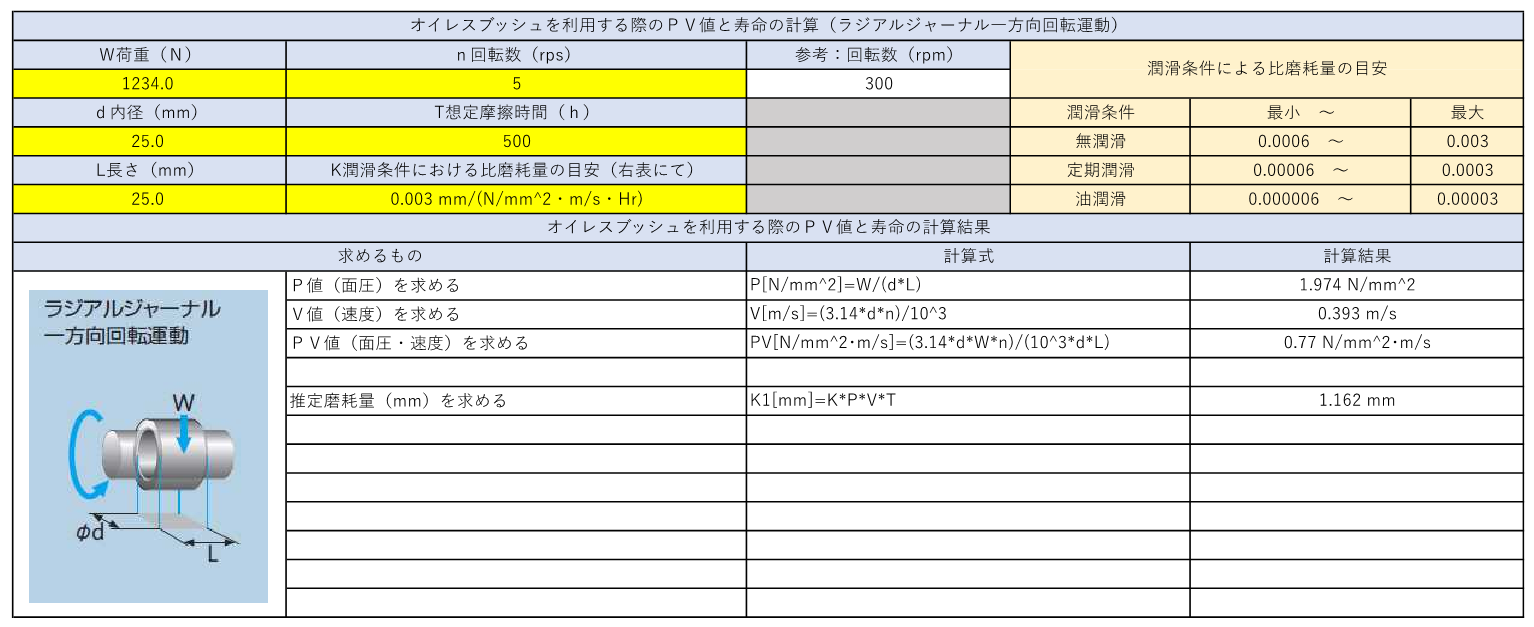
The required information is as follows
- W load (N)
- d Inner diameter (mm)
- n RPM (rps)
- L Length (mm)
- T Assumed friction time (h)
- Approximate specific wear rate under K lubrication conditions (mm/(N/mm^2-m/s-Hr))
Radial journal unidirectional rotary motionThe PV value and lifetime of the
- Find P value (surface pressure): P[N/mm^2]=W/(d*L)
- Find the V value (velocity): V[m/s]=(3.14*d*n)/10^3
- Calculate PV value (surface pressure and velocity): PV[N/mm^2-m/s]=(3.14*d*W*n)/(10^3*d*L)
- Find the estimated amount of wear (mm): K1[mm]=K*P*V*T
swinging motionCalculate the PV value and lifetime of
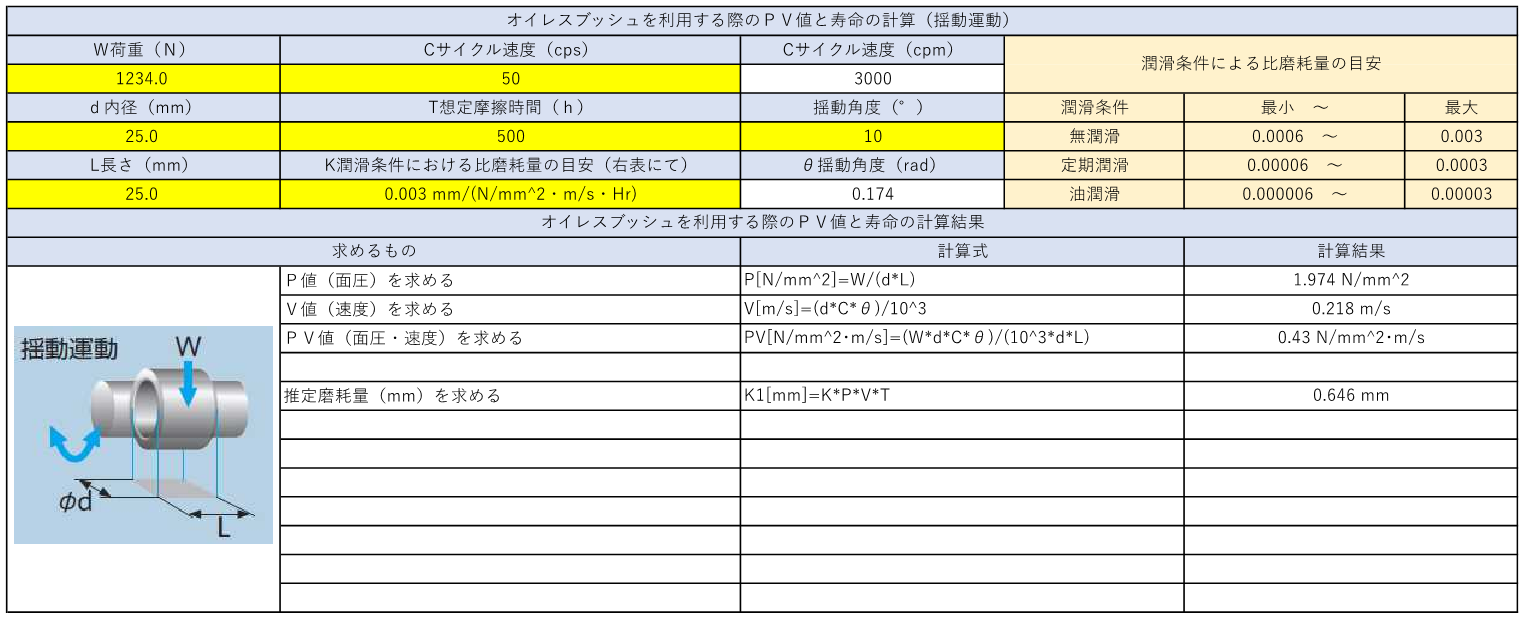
The required information is as follows
- W load (N)
- d Inner diameter (mm)
- L Length (mm)
- C cycle rate (cps)
- θ Oscillation angle (rad)
- T Assumed friction time (h)
- Approximate specific wear rate under K lubrication conditions (mm/(N/mm^2-m/s-Hr))
swinging motionThe PV value and lifetime of the
- Find P value (surface pressure): P[N/mm^2]=W/(d*L)
- Find V value (velocity): V[m/s]=(d*C*θ)/10^3
- Obtain PV value (surface pressure and velocity): PV[N/mm^2-m/s]=(W*d*C*θ)/(10^3*d*L)
- Find the estimated amount of wear (mm): K1[mm]=K*P*V*T
reciprocating motionCalculate the PV value and lifetime of

The required information is as follows
- W load (N)
- d Inner diameter (mm)
- L Length (mm)
- C cycle rate (cps)
- S stroke (mm)
- T Assumed friction time (h)
- Approximate specific wear rate under K lubrication conditions (mm/(N/mm^2-m/s-Hr))
reciprocating motionThe PV value and lifetime of the
- Find P value (surface pressure): P[N/mm^2]=W/(d*L)
- Find the V value (velocity): V[m/s]=(2*C*S)/10^3
- Find PV value (surface pressure and velocity): PV[N/mm^2-m/s]=(2*W*C*S)/(10^3*d*L)
- Find the estimated amount of wear (mm): K1[mm]=K*P*V*T
Low PV values are seen in high temperature use
At high temperatures, it is difficult to dissipate frictional heat, resulting in reduced friction characteristics.Therefore, please design the product with a sufficient margin for use at high temperatures.
General Knowledge of Bearings "Intermittent operation gives good results for bearings."
I think there are two patterns of intervals between operations, either continuous or intermittent,Compared to continuous operation, the temperature of the friction surface drops during the interval of intermittent operation.Therefore, it is believed that intermittently running the bearings will produce better results than continuously running them.
[IMPORTANT] There is a way to consider the proper size of oilless (oilless) bushings.
The shaft diameter and bearing length must be selected for oilless (oilless) bushings, but the "Bearing length / Bearing bore diameter = Ratioshould be adjusted according to the application. For details, see "How to consider the proper size of oilless (oilless) bushingsPlease also see the article in the "How to make the best use of your time" section of this website.
Download Calculation Excel
Here you can download the Excel sheet "Calculation of PV value and lifetime when using oilless (oilless) bushings". Please use it.

That's it.