Here."How to Calculate Tension by Suspension Angle."is noted down. This calculation can be applied to tension on wires applied when suspending heavy objects with eyebolts, etc.
Calculation of Tension by Suspension Angle
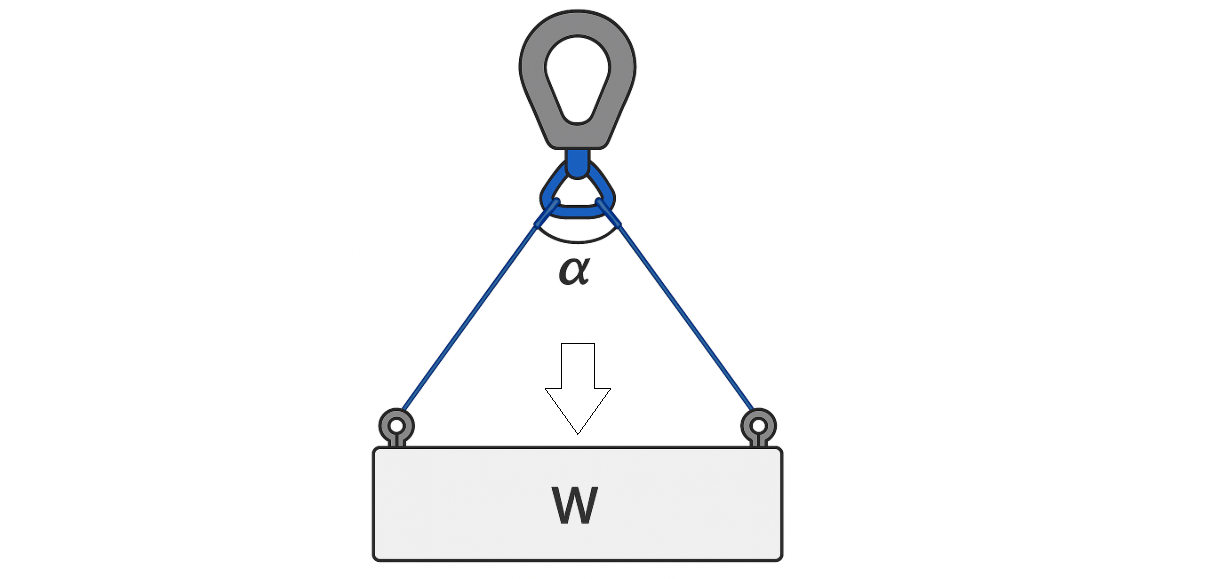
When slant suspension is performed with two, three, or four eyebolts attached to the object to be lifted, the tensile load (tension) on the wire (sling) varies greatly depending on the suspension angle (inclination of the wire).
When hanging at an angle, the load (tension) applied per wire has the characteristic that the greater the hanging angle (wire angle), the greater the load (tension) per wire.If the angle is wide, a stronger horizontal pull is required and the tension increases. That is, when a suspended load is supported by multiple wires,
- The closer the wire is to vertical, the less tension is required.
- The closer the wire is to horizontal, the greater the tension. (Stronger wire is needed)
will be.
Tension Formula
T = W / (n × cosθ)
- T: Tension applied to one wire (N or kgf)
- W: Weight of object to be lifted (N or kgf)
- n: Number of suspension points (number of wires; 2 for 2-point suspension, 4 for 4-point suspension)
- α: Angle of the wire
*The calculation uses "cosθ" in the angle part. If α = 30, it is half cos15°, and if 45, it is cos22.5°.
Specific example 1
2-point suspension, weight 1,000 kg, suspension angle α30° = cos15°.
- W = 1,000 kg
- n = 2
- α = 30° (cos15°= 0.96593)
T = 1,000 / (2 × 0.96593) = 517kgf → One wire is subjected to a tension of 517 kgf.
Specific example 2
2-point suspension, weight 1,000 kg, suspension angle α45° = cos22.5°.
- W = 1,000 kg
- n = 2
- α = 45° (cos22.5°= 0.92388)
T = 1,000 / (2 × 0.92388) = 541 kgf → One wire is subjected to a tension of 541 kgf.
Example 3
2-point suspension, weight 1,000 kg, suspension angle α60° = cos30°.
- W = 1,000 kg
- n = 2
- α = 60° (cos30° = 0.86603)
T = 1,000 / (2 × 0.86603) = 577 kgf → One wire is subjected to a tension of 577 kgf.
Example 4
4-point suspension, weight 1,000 kg, suspension angle α60° = cos30°.
- W = 1,000 kg
- n = 4
- α = 60° (cos30° = 0.86603)
T = 1,000 / (4 × 0.86603) = 288 kgf → One wire is subjected to a tension of 288 kgf.
*A total of four wires are assumed to be equally attached to the top surface of the object.
※If it is difficult to apply the load evenly by suspending at 4 points, calculate the load by suspending at 3 points.
reference value
θ = 15.0° → cos(15.0°) = 0.96593
θ = 17.5° → cos(17.5°) = 0.95372
θ = 20.0° → cos(20.0°) = 0.93969
θ = 22.5° → cos(22.5°) = 0.92388
θ = 25.0° → cos(25.0°) = 0.90631
θ = 27.5° → cos(27.5°) = 0.88701
θ = 30.0° → cos(30.0°) = 0.86603
θ = 32.5° → cos(32.5°) = 0.84339
θ = 35.0° → cos(35.0°) = 0.81915
θ = 37.5° → cos(37.5°) = 0.79335
θ = 40.0° → cos(40.0°) = 0.76604
θ = 42.5° → cos(42.5°) = 0.73728
θ = 45.0° → cos(45.0°) = 0.70711
attention (heed)
The above calculations are for applied tension, and the breaking strength of the wire to be used should be multiplied by an appropriate safety factor.
That's it.