Here.Fundamentals of Explosion-Proof Design."notes.Basic knowledge that serves as an entry point for those who are learning about explosion protection designWe have compiled a list of all the information. Please take a look at it for reference.
- Explosion-proof design
- (1) Basic knowledge of explosion-proof design
- (2) Explosion-proof construction
- 2-1 Explosion-proof construction
- 2-2 Oil-filled explosion-proof construction
- (2)-3 Internal pressure explosion-proof construction
- 2-4 Safety-enhanced explosion-proof construction
- 2-5 Intrinsically safe explosion-proof construction
- 2-6 Non-ignition explosion-proof construction
- Resin-filled explosion-proof construction
- About explosion-proof symbols
- summary
Explosion-proof design
(1) Basic knowledge of explosion-proof design
In mechanical designTo meet explosion-proof specifications, the design must reduce the risk of explosions, especially in environments where flammable gases and dust are present, and care must be taken to ensure that electrical equipment and mechanical components do not become ignition sources.
1-1 Three factors that cause explosions
- Combustible materials (fuel)Flammable gases, vapors, dusts
- Oxygen (auxiliary flame retardant substance)Oxygen in the air
- Ignition sourceSparks, hot surfaces, static electricity, etc.
Explosion-proof design requires measures focusing on the ignition source.
(1)-2 Standards and Criteria for Explosion Protection
Explosion-proof specifications are standardized in each country and must be designed in accordance with those standards.
- Japanese Standard, JIS C 60079: TIIS (Labor Inspection), JIS C 60079
- International Standard: IEC 60079 (IECEx)
- European Standard: ATEX (EN 60079)
- U.S. Standard: NEC 500/505 (NFPA, UL)
(1)-3 Laws and regulations concerning explosion protection
Laws and regulations concerning explosion protection are as follows
- Industrial Safety and Health Law: Article 42, Article 44
- Ordinance on Industrial Safety and Health: Article 280
- Cabinet Order based on Fire Service Act: Article 9, Paragraph 1, Item 17
- Interpretation of technical standards for electrical equipment: Article 176
①-4 Classification of Hazardous Locations (Classification)
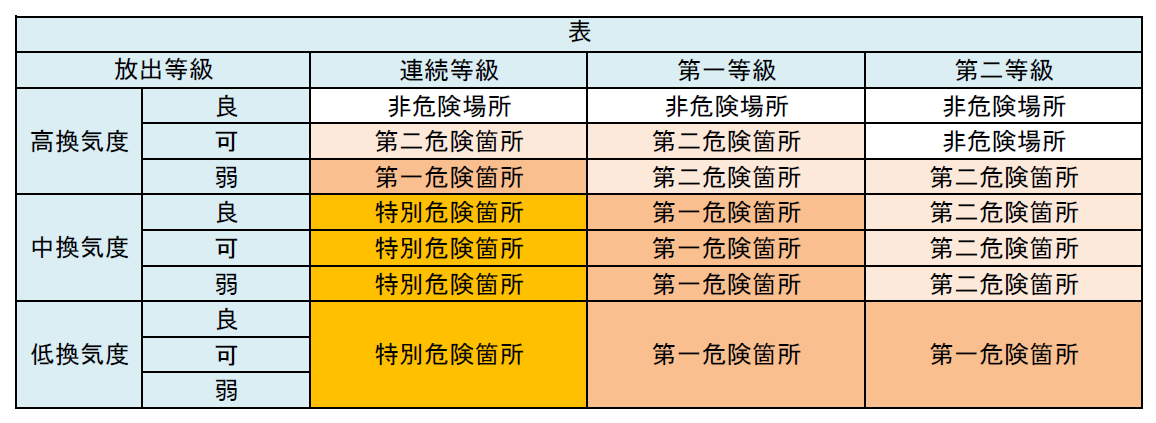
Hazardous areas are classified as follows
- Special Hazardous Locations (Class 0 locations, Zone 0): Where explosive atmospheres are present for "continuous, prolonged, and frequent" periods of time.
- Class 1 Hazardous Locations (Class 1 Location, Zone 1): Where explosive atmospheres can often be generated.
- Category 2 hazardous location (Class 2 location, Zone 2): Locations where there is little or short risk of generating an explosive atmosphere.
[Supplemental
I know that the class of the emission source, ventilation degree, effectiveness of ventilation, etc. are used as factors to determine the extent and classification of the hazardous area,Classification of hazardous locations is determined by persons with knowledge of the characteristics of flammable materials, the processes leading to explosions, and the equipment used, in consultation with the relevant engineers.The first two are the following.
(1)-5 Grades of emission sources and ventilation/effectiveness
Depending on the frequency with which explosive atmospheres are generated and the likelihood of leakage, etc., release sources can be classified as follows
- Continuous grade emission source: Continuous release of flammable materials, prolonged release, high frequency release sources
- primary source: sources of release that are expected to release flammable materials on a regular basis.
- Second grade emission sourceFlammable materials: Sources that are not expected to release flammable materials, and if they do release them, it will be of low frequency and for short periods of time.
In addition, the following classifications indicate the degree of ventilation for these emission sources.
- high ventilationVentilation capacity that can instantly reduce the concentration of flammable gases to below the lower explosive limit.
- ventilation dilationVentilation capacity that can control or reduce the increase in the concentration of flammable gases when they continue to be released.
- low ventilationVentilation capacity that is unable to control or reduce the increase in the concentration of flammable gases when the release of such gases continues.
*Less than the lower explosive limit refers to a condition in which the mixture concentration of combustible gas and air or oxygen is lower than the lower explosive limit.
The following are validity
- 良Continuous ventilation: Continuous ventilation is provided. (In case of failure of the ventilation system, a backup ventilation system should be used, etc.)
- 可: If a brief stoppage of ventilation is permissible.
- 弱: If there are no prolonged ventilation shutdowns.
Putting all of these together, we get the followingThis is how we determine where the hazardous areas are.
(2) Explosion-proof construction
Explosion-proof design can be broadly classified into the following methods, and each applicable explosion-proof structure is defined according to the "type of hazardous location.
2-1 Explosion-proof construction
In a totally enclosed structureA structure that allows the container to withstand the pressure of an internal explosion without risk of igniting external explosive gases.
Examples of applications include motors, switches, lighting, etc. Specifically
Solid metal enclosure (aluminum, cast iron, stainless steel)
Design appropriate clearances at joints (prevent flame passage)
Structural design to withstand internal explosion pressure (test: pressure resistance 1.5 times, etc.)
2-2 Oil-filled explosion-proof construction
The part where electric sparks are generated is contained in oil.Structure that will not ignite explosive gases present on the oil surface.
(2)-3 Internal pressure explosion-proof construction
Preventing the entry of explosive gases by maintaining internal pressure by pressurizing the container with protective gas (clean air or inert gas), etc.The structure is designed to be used for the following applications. Examples of applications include air purge systems for maintaining positive pressure and alarm functions for pressure drops in control panels and analyzers.
2-4 Safety-enhanced explosion-proof construction
Increased structural and temperature rise safety to prevent electrical sparks or high temperatures.underlying structure
Examples of applications include sensors, measuring instruments, and communication devices, to name a few.
- Limits on circuit voltage and current (24 V or less, typically 12 V or less)
- Use of current-limiting resistors
- Application of Zener and isolation barriers
These include.
*Zener barrier is a device that prevents the inflow of excessive current by utilizing the action of a zener diode.
*Isolation Barrier Isolation isolation or barrier that prevents or isolates electrical connections.
For explosion-proof motors often used in mechanical design, to prevent the windings inside the motor from generating heat, use insulating materials of heat resistance class F (155°C) or higher, strengthen the insulation between the layers of the windings, and control the coil temperature. (Embedded shutdown in case of abnormal heating)
Cooling fins and ventilation ducts have been added, and sealed grease is used on the bearings to prevent sparking.
2-5 Intrinsically safe explosion-proof construction
Due to electric spark or high temperature generationStructure that has been confirmed by an official body not to ignite explosive gas
2-6 Non-ignition explosion-proof construction
In abnormal conditions,Explosion-proof construction applicable to electrical equipment that is not capable of igniting surrounding flammable materials
Resin-filled explosion-proof construction
An explosion-proof construction in which parts capable of igniting surrounding flammable materials are enclosed in resin to prevent them from becoming ignition sources.Completely encapsulate electrical components with resin or gel to prevent contact with flammable gases.Examples of applications include electronic substrates and sensors, which are completely encapsulated with epoxy resin or silicon.
ポFor the input, selection of sealing material, removal of air bubbles during sealing, and consideration of thermal expansion after sealing (considering breakdown due to stress concentration) should be taken into account. Epoxy resins are characterized by high heat resistance and insulation, while silicone resins are flexible and resistant to temperature changes.
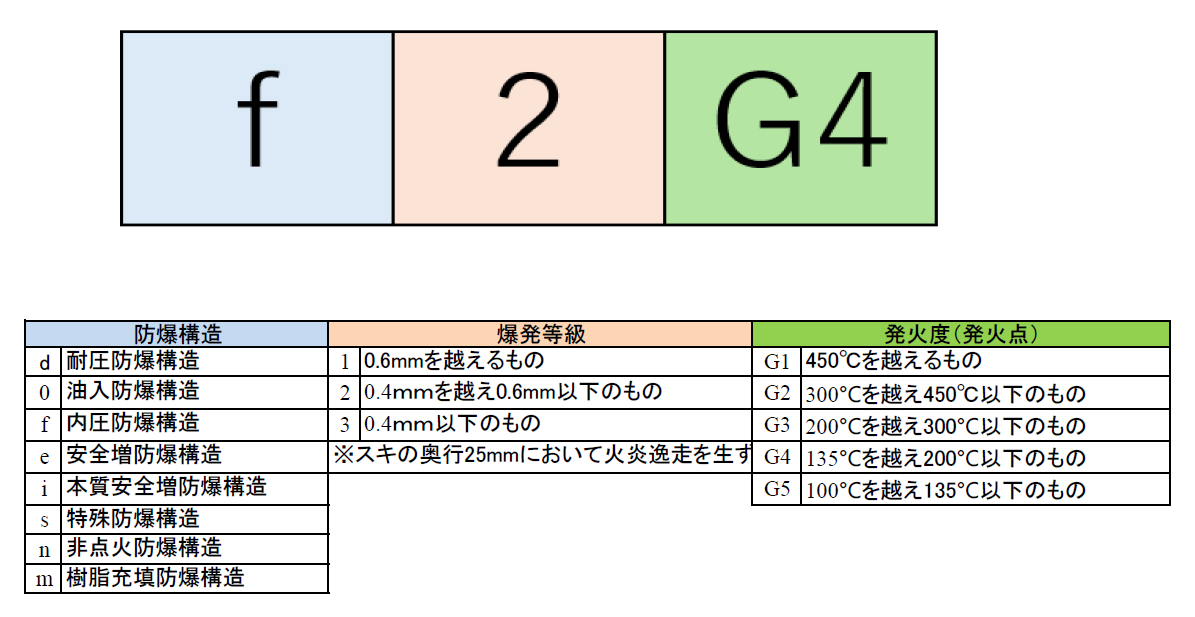
About explosion-proof symbols
Explosion-proof symbol is a symbol indicating the explosion-proof construction of the equipment (product) and the flammable atmosphere (performance) in which the product can be used.
summary
When explosion-proof design is used in mechanical design, there are several options available, such as using explosion-proof equipment or using ordinary products that are explosion-proof externally to eliminate ignition sources.
I personally think it is difficult to select the appropriate explosion-proof method (intrinsically safe, explosion-proof construction, etc.) for the operating environment, but as I mentioned in the articleTo be determined by a person with knowledge of the classification of hazardous locations, the characteristics of flammable materials and processes leading to explosions, and the equipment used, in consultation with the relevant engineers. (I think it is very important to have a good understanding of the legal standards and to consult with a certification body. (Ultimately, it may be necessary to consult with a legal compliance and certification organization.)
That's it.