Here.Terms related to "steel types, crude steel, and steel billets notes.
Terms for steel types, crude steel, and steel billets
1100 Pure iron
Iron with very low levels of carbon and other impurity elements. There is no clear distinction regarding the limits of impurity elements, but up to about 0.021 TP3T of carbon content is referred to as pure iron. Electrolytic iron, armco iron, carbonyl iron, and reduced iron are treated as pure iron.
1101 Electrolytic iron
Pure iron obtained by electrolysis of aqueous iron salt solutions. Usually, the impurity elements contained are less than 0.0051 TP3T of carbon, 0.0051 TP3T of silicon, 0.0051 TP3T of manganese, 0.0041 TP3T of phosphorus, and 0.0051 TP3T of sulfur.
1102 Carbon steel
A steel alloy of iron and carbon with a carbon content usually ranging from 0.02 to about 21 TP3T. It usually contains small amounts of silicon, manganese, phosphorus, and sulfur. For convenience, carbon steels are further classified by carbon content or hardness (strength is also included). Carbon steels may be further classified according to their carbon content or hardness (including strength) as follows
Classification by carbon content Low carbon steel, medium carbon steel, high oxygen steel
Classification by hardness Ultra mild steel, mild steel, hard steel
1103 Alloy steel
A steel that contains one or more alloying elements to improve the properties of the steel or to give it certain characteristics.
The criteria for alloying element content differ slightly from ISO, but the Customs Co-operation Council classification refers to steels whose chemical composition is equal to or greater than the following values
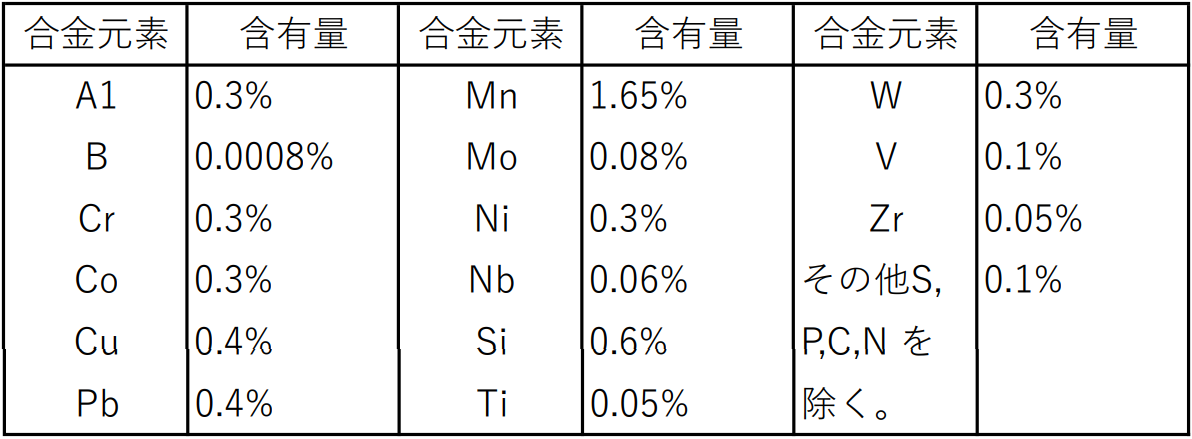
For convenience, the steel is sometimes referred to as high-alloy steel or low-alloy steel, depending on the alloying element content.
1104 Superalloy
Alloys in which a large amount of alloying elements are added to improve the corrosion or heat resistance of the steel, and the iron content is approximately 50% or less.
1121 Rimmed steel
Oxygen and carbon in the molten steel interact in the mold to produce carbon monoxide, which solidifies while the molten steel undergoes a peculiar boiling stirring motion (called liming action). The steel solidifies while undergoing the unique boiling and stirring (liming action) motion of molten steel.
Steel made by adding ferromanganese and a small amount of aluminum as deoxidizers. The surface layer is clean, but there is some bias fracture.
1122 Capped steel
Steel in which a deoxidizer is added shortly after the unoxidized molten steel is injected into the mold, or the mold is covered to force the liming action to end early and allow the interior to solidify quietly.
The former is called chemical capped steel and the latter is called mechanical capped steel. Capped steel has a clean surface layer like rimmed steel and a less deviated interior like semi-killed steel, and attempts to offset shrinkage pores by means of air bubbles.
1123 Semi-killed steel
A steel that has been deoxidized to an intermediate level between limed and killed steel by adding appropriate amounts of ferromanganese, ferrosilicon, aluminum, etc. as deoxidants. It is a steel in which some bubbles are generated as solidification progresses to reduce shrinkage pores due to solidification.
1124 Killed steel
Steel that has been sufficiently deoxidized with ferrosilicon or aluminum. It solidifies quietly without producing carbon monoxide during the solidification process in the mold, and is relatively homogeneous with little breakage and no bubbles, but shrinkage holes form in the upper center and yield is not good. Killed steels are further classified according to grain size or deoxidizers as follows
(a) Classification by grain size
Coarse-grained Killed Steel: Killed steel with an austenitic grain size of less than grain size number 5.
Fine-grained Killed Steel: Killed steel with an austenitic grain size and a grain size number of 5 or higher.
(b) Classification by deoxidizer
silicon-killed steel
Aluminum (Nium) Killed Steel
Silicon Aluminum (Nium) Killed Steel
Reference deoxidation: The removal of oxygen from molten steel by adding elements such as silicon, manganese, and aluminum. Steel is classified into quilled steel, semi-quilled steel, capped steel, and limed steel according to the degree of deoxidation.
That's it.