Here.How to Select an Industrial Sponge|Thorough Comparison of Materials, Uses, and Processing. notes.
The characteristics of industrial sponges vary greatly depending on their materials and structures, and selecting the wrong one for the application can lead to defects due to insufficient performance and waste of money. To select the most suitable sponge,How to make a rational choice based on an in-depth understanding of the many different types and properties of each material, and a proper comparison of the different applications. is essential.
This article is intended for machine designers who are concerned about selecting industrial sponges as part of their machine structures, and provides a comprehensive and easy-to-imagine explanation of the basics of sponges, detailed characteristics of each major material, and the best selection method based on application, performance, and even processing and installation methods.
- Basics and main types of industrial sponges
- Types of rubber sponges and their respective characteristics
- Types of plastic-based sponges and their specialties
- How to choose the type of sponge to compare by application
- Selecting the best sponge type based on performance
- Processing method for each sponge material
- How to install each sponge
- Summary: All knowledge for optimal sponge selection
Basics and main types of industrial sponges
When choosing a sponge as a machine part, the first thing to understand is the basic structure and material differences It is. Here we will explain the most important fundamentals to properly understand the wide variety of industrial sponge types.
What is the cell structure that determines the characteristics?
The most fundamental element that determines the performance of a sponge is its internalNumerous bubble structures called "cells It is. This cell structure determines the fundamental function of the sponge, whether it allows liquids and air to pass through or blocks them.
Let me put it this way,It is no exaggeration to say that this cell structure almost determines what applications it can be used for. There are two major types of cell structures: "independent bubbles" and "continuous bubbles," and understanding the difference between them is the first step in material selection.
Function of Independent Bubble Sponge
Independent bubble sponge has a structure in which each internal bubble is completely independent. has a Because each bubble is separated by a wall like a balloon,It does not allow water, air, or gases to pass through. For this reason, it plays an active role in applications that require high airtightness and watertightness.
For example, it is commonly used as a sealing material to prevent water and oil from penetrating and as a heat insulator to prevent heat transferIt is It is also lightweight and buoyant because the gas is trapped inside.In mechanical design, this type of sponge is chosen for waterproof and dustproof gaskets, gaskets, and heat insulators for piping.
Sponge with mainly closed cell structure
The internal air bubbles are independent and impervious to water and air, making it suitable for sealing and heat insulation materials.
- NBR Sponge
- Chloroprene Rubber Sponge (CR Sponge)
- EPDM Sponge
- Silicone Rubber Sponge
- Fluoro Rubber Sponge
- Polyethylene foam sponge
Continuous bubble sponge function
On the other hand,Continuous bubble sponge has a structure in which internal bubbles are connected to each other like a mesh.It is. The air bubbles are connected, allowing air and liquids to pass freely through the sponge. This characteristic is utilized,Sound absorbing materials to absorb sound, filters to filter liquids and dust, and cushioning materials to absorb shock while maintaining breathability. It is used for such purposes as
Because sound waves are attenuated by its complex internal structure, it is used as a noise reduction material for machinery, and because of its breathability and flexibility, it can be used as a cushioning material inside electronic equipment and as a material for the construction of new buildings,Cushioning material for areas that people touchIt can also be employed as a
Sponge with a predominantly continuous cell structure (open cell)
The air bubbles inside are connected, allowing air and sound to pass through, making it suitable for sound absorbers, filters, and breathable cushioning materials.
- Melamine foam sponge
Sponge with both structures present
Depending on the manufacturing method, both types of bubbles, independent and continuous, are produced.
- Urethane sponge (Polyurethane sponge)
Base polymer from which the material is made
Along with the cell structure, it is also important,Base polymer" which is the basis of spongeis. This refers to the difference in materials, whether the sponge is made of rubber or plastic. The base polymer determines the basic chemical properties of the sponge, such as heat resistance, oil resistance, and weather resistance.
In other words, the basic flow of material selection is to first determine the general function of the cell structure, i.e., "to pass or not to pass fluid," and then select the optimal base polymer according to the operating environment (temperature, presence or absence of oil, outdoor or indoor, etc.). ThisOnly by combining the two factors correctly can a sponge be selected that meets the required specifications.
Types of rubber sponges and their respective characteristics
Sponges made from rubber-based polymers combine the elasticity and resilience characteristic of rubber with the superior durability of each material. Let's take a closer look at the typical types of rubber sponges and the characteristics of each.
NBR sponge with excellent oil resistance
NBR (nitrile rubber) sponge's greatest feature is its excellent resistance to oils such as mineral oil, fuel, and grease. It is. This property is derived from the acrylonitrile content of the raw material and provides the advantage of less dimensional change and physical property degradation in environments where it is exposed to oil.
Therefore, it is best suited for parts used in environments where it is in direct contact with oil or splashed with oil, such as around automobile engines, oil seals for industrial machinery, and packing for hydraulic equipment. Its excellent abrasion resistance also makes it suitable for use in sliding parts.
However, the NBR does not includeClear Weaknesses also exist. Due to their low resistance to weathering and ozone, they are not suitable for use in outdoor environments where they are directly exposed to ultraviolet rays and ozone. Prolonged exposure may cause cracking or other deterioration. Therefore, when considering the use of NBR, it is essential to confirm that while resistance to oil is required, it is not for outdoor environments.
Hardness of NBR sponge (Asker C hardness)
Hardness of NBR sponge is,Typically 20 to 30 degrees in Asker C. It is. This hardness is a little firmer than that of a dish-washing sponge and has moderate elasticity. In sealing applications, this hardness is suitable for maintaining the necessary resilience while moderately following the unevenness of the mating material.
*Asker C hardness is explained in detail in the following section.
Balanced chloroprene rubber sponge
Chloroprene rubber (CR) is a "versatile" sponge that offers a good balance of many performance characteristics such as oil resistance, weather resistance, heat resistance, and mechanical strength. It is. Although not outstanding in any particular performance, they are used in a great many fields because they can demonstrate a certain level of performance in a wide range of environments.
Because of this versatility, there are countless applications ranging from sealing materials for general industrial use, automotive parts, insulation materials for construction, and packing materials for electrical equipment. Also,Easily flame retardant and available in a wide range of grades that meet UL and other safety standards I will do so.
However,This "balanced" characteristic is also a point of caution in the selection process. Since not all performance is at the highest level, more specialized materials should be considered, for example, NBR for particularly stringent oil resistance requirements, or EPDM for extremely high weather resistance. CR is a convenient option, but it is important to check the specifications in detail to determine if the material is over-specified or under-performing.
Hardness of chloroprene rubber sponge (Asker C hardness)
CR sponges are characterized by the fact that they are commercially available in a very wide range of hardness. They range from very soft, such as 8 degrees in Asker C, to standard 20-25 degrees, and even harder, such as 45-50 degrees,Various selections are available depending on the application.They are. The softer ones are better suited for following complex shapes, while the stiffer ones are suitable for maintaining high sealing pressure.
*Asker C hardness is explained in detail in the following section.
EPDM sponge with strong weather resistance
EPDM (ethylene-propylene-diene rubber) sponge is extremely resistant to weather, ozone, and ultraviolet rays. The chemical structure of the rubber's main chain, which does not contain double bonds, makes it resistant to degradation by ozone and ultraviolet rays, and allows it to maintain stable performance over a long period of time, even in harsh environments where it is exposed outdoors to wind, rain, and direct sunlight.
Typical applications include door seals and trunk seals for automobiles and gaskets (weather strips) for window frames in buildings. They also have excellent water and chemical resistance (especially to acids and alkalis).
On the contrary,EPDM has clear weaknesses The following is a list of the most common reasons for this. EPDM and NBR are extremely sensitive to hydrocarbon-based oils, such as mineral oil and gasoline, and should never be used in areas where oil may be splashed. It is important to remember that EPDM and NBR are a perfect trade-off in terms of weather resistance and oil resistance, so there is no confusion in material selection.
Hardness of EPDM sponge (Asker C hardness)
EPDM sponges, like CR, are offered in a variety of hardnesses. The lineup ranges from very soft types, such as 6 to 8 degrees for Asker C, to general-purpose 20 to 25 degrees, and harder types exceeding 30 degrees. The softer grades, in particular, can be compressed with light force, making them suitable for waterproof and dustproof seals where large gaps and high adhesion are required.
*Asker C hardness is explained in detail in the following section.
Silicone sponge with high heat resistance
Silicone sponge boasts exceptional heat and cold resistance, setting it apart from other organic rubber-based sponges. Since the main backbone is composed of strong siloxane bonds, it can be used stably over a very wide temperature range, generally from -60°C to 200°C, with little change in physical properties.
Because of these characteristics, it is used in packing for cooking appliances and industrial ovens that are subject to high temperatures, high-temperature parts around automobile engines, and conversely, sealing materials for freezing and refrigeration equipment that are used in low-temperature environments.The material itself is clean, and some grades conform to the Food Sanitation Law and FDA (U.S. Food and Drug Administration) standards, making them useful in the food and medical fields.
Of course, it is not a panacea. Mechanical strength,Tear strength and abrasion resistance in particular tend to be lower than other rubbersThere are It should also be considered that it is expensive. It also has the aspect of being weak against strong acids, strong alkalis, and some solvents.
Silicone sponge hardness (Asker C hardness)
The hardness of silicone sponge is generally supplied in the range of 20 to 50 degrees on an Asker C. In particular, there are many products that are specified as around 20 degrees on the "Type E" hardness scale, which is used to measure materials even softer than Asker C. This material is a material for which a balance between hardness and compression set is important in order to maintain stable resilience even under high temperatures.
*Asker C hardness is explained in detail in the following section.
Fluorine rubber sponge, the trump card for chemical resistance
Fluorine rubber (FKM) sponge has the highest heat resistance and chemical resistance among rubber-based sponges. The abundance of fluorine atoms in the molecule provides extremely strong chemical stability and excellent durability against many chemicals, solvents, and oils. There are also grades with continuous use temperatures exceeding 200°C, making them trulyIt is a material for extreme environments.
Major applications include sealing materials in chemical plants, components in semiconductor manufacturing equipment, fuel systems in the aerospace industry, and other special environments where other materials cannot endure. They demonstrate their true value in situations where the highest reliability is required.
With this understanding, it is important to take into account that it is the most expensive of all sponge materials. There are also some caveats, such as its inflexibility at low temperatures and its resistance to some polar solvents, such as ketones and esters.Areas where fluoro rubber sponges are used suggest such a harsh environment that easy substitution may lead to serious failures.
Hardness of fluoro rubber sponge (Asker C hardness)
Because fluoro rubber sponge is a special material, it does not have as many variations in hardness as other general-purpose rubbers. Generally, the standard hardness is around 30 degrees on the Asker C scale, but softer types of around 15 degrees also exist. To ensure reliable sealing performance in harsh environments, the product combines moderate hardness with excellent compression set.
*Asker C hardness is explained in detail in the following section.
Types of plastic-based sponges and their specialties
Foam (sponge) made from plastic exhibits unique properties in terms of light weight, thermal insulation, and cushioning The following is a list of typical plastic sponges that are different from rubber sponges. We will introduce typical plastic-based sponges, which have different areas of expertise from rubber-based sponges.
Diverse urethane foam sponge properties
Urethane foam is a very versatile sponge whose properties can be greatly adjusted by changing the blend of polyol and isocyanate, the raw materials.It can be made from hard to very soft, and both independent and continuous bubbles can be produced in the cell structure.
Differences by type of polyol
The basic properties of urethane foam are broadly bifurcated according to the type of polyol used as the main raw material.
- Polyester-based It has excellent mechanical strength, abrasion resistance, and oil resistance. However, it has a fatal weakness: when exposed to moisture, it is prone to degradation due to a chemical reaction called hydrolysis.
- Polyethers: Polyethers It is resistant to hydrolysis and has excellent water resistance. It also has high resilience and cushioning properties. On the other hand, its mechanical strength is inferior to that of polyester.
Differences in Applications by Cell Structure
As mentioned earlier, applications vary depending on the cell structure.The continuous cell type is used for sofa cushions, bedding mattresses, sound-absorbing materials, filters, etc. due to its flexibility and air permeability.On the other hand,The independent bubble type is designed to provide excellent heat insulation performance by trapping gas inside,Used as heat insulation panels for construction, wall materials for cold storage, etc. will be used. Thus, when selecting a polyurethane foam, it is essential to check both the polyol type and the cell structure.
Urethane foam sponge hardness (Asker C hardness)
Urethane foam exists in an extremely wide range of hardness, from very soft (less than 20 degrees in Asker C) to hard (over 80 degrees). In particular, an ultra-soft urethane gel (close to 0 in Asker C) that feels like human skin has been developed, and its diversity is unrivaled by any other material.
*Asker C hardness is explained in detail in the following section.
Lightweight polyethylene foam sponge
Polyethylene foam (PE) is characterized by its extremely light weight, yet toughness and excellent cushioning properties. Its independent cell structure makes it impervious to water, buoyant, and chemical resistant. Because of this ease of handling and cost performance, PE is used in a wide range of fields.
The most typical use is as a packing and cushioning material when transporting precision equipment and home appliances. They are used as spacers in boxes to protect products from shocks. It is also used as aIts applications range from daily necessities to industrial products, such as building insulation and pipe heat insulation covers, taking advantage of its excellent heat insulating properties, and swimming beat boards and yoga mats, taking advantage of its buoyancy. There are also grades that are chemically cross-linked to further enhance heat resistance and mechanical strength.
Hardness of polyethylene foam sponge (Asker C hardness)
PE foam and similar EVA foams are available in a great variety of hardness. Products of various hardnesses are made by adjusting density and foaming ratio, from as soft as 10 degrees on the Asker C scale to as hard as 75 degrees. Soft materials tend to be selected as cushioning materials, while hard materials are selected as structural materials.
*Asker C hardness is explained in detail in the following section.
Melamine foam sponge, excellent sound absorbing material
Melamine foam is a continuous cell foam made from melamine resin and has several outstanding characteristics. First, it is extremely lightweight, yet has outstanding sound absorption performance. Its fine three-dimensional mesh structure effectively absorbs and attenuates sound energy, making it ideal as a soundproofing material for recording studios, audio rooms, and the engine rooms of railroad cars and machinery where quietness is required.
Second, it also has excellent heat insulation performance. Another is its "self-extinguishing" property, which means that the material itself is flame-resistant without the addition of flame retardants. Melamine resin, which contains a large amount of nitrogen, generates nonflammable nitrogen gas when it burns, which shuts off oxygen and extinguishes the fire. This high level of safety has led to its adoption in a variety of fields. On the other hand, it is important to understand that it is physically brittle and can easily chip when strong force is applied.
Hardness of melamine foam sponge
Melamine foam is classified as a "hard foam," which is hard and brittle, unlike rubber and soft plastics The hardness of the material is measured by the Asker C hardness tester. Therefore, it is not common to measure hardness with an Asker C hardness tester. Instead, hardness is often indicated by the stress (kPa) when compressed with a certain force. On a microscopic scale, the skeletal structure has a Mohs hardness of 4, comparable to that of the mineral fluorite, but as a whole it exhibits the unique characteristic of being brittle due to its high porosity.
How to choose the type of sponge to compare by application
After understanding the characteristics of each sponge material so far, the next step is to select the most suitable one based on the specific "usage.Here is a comparison of what kind of sponge is suitable for each typical application I will do so.
Sponge utilization as sealant
The role of sealing materials is to prevent liquids, gases, and dust from leaking or entering the joint surfaces of parts and components. To achieve this objective, the ability to reliably intercept fluids is essential.
Therefore, when selecting a sponge as a sealing material, the first choice is a sponge with an "independent bubble" structure that does not allow water or air to pass through. A continuous bubble sponge will not work as a sealing material because fluid will pass through its interior.
The base polymer is then narrowed down according to the environment in which it will be used. For example, EPDM has high weather resistance for outdoor locations exposed to rainwater, NBR has oil resistance for locations exposed to engine oil, and silicone has heat resistance for locations exposed to high temperatures. In this way, the royal road to selecting sealing materials is to first narrow down the function by cell structure, and then determine the material based on environmental factors.
Role of gaskets and packing
Among sealing materials, "gaskets" and "packings" are the most commonly used components. Although they are strictly distinct, they serve the same purpose of preventing leakage.
- Gaskets: Gasket Sealant is mainly used to fill gaps in immovable parts (fixed parts), such as pipe flanges and equipment covers.
- Packing It is mainly used to seal moving parts (kinematic parts) such as the shaft of a pump or the piston of a cylinder, but it is also used for fixed parts.
Regardless of which application, the sealing function is still required. As mentioned above, it is important to select the most suitable material (EPDM, NBR, CR, silicone, etc.) from among sponges with independent bubble structure, taking into consideration the conditions of temperature, pressure, and fluid in contact at the point of use.
Points for selecting heat-blocking insulation
Insulation materials are used to reduce heat transfer, retain heat or cold, or provide thermal protection for surrounding components. The air contained in the numerous air bubbles inside the sponge hinders heat transfer (conduction, convection, and radiation), thereby creating a high heat-insulating effect.
To maximize this effect, the air in the bubbles must be trapped without moving. For this reason, sponges with an airtight "independent bubble" structure are suitable for insulation.
For general insulation, polyethylene foam, which is lightweight and cost-effective, and EPDM, which is also weather resistant, are often used; silicone sponge is the material of choice for high-temperature environments above 100°C, and ceramic foam for even higher temperatures, such as industrial furnaces. Melamine foam also provides excellent thermal insulation due to its low thermal conductivity.
How to choose cushioning material to protect against impact
Cushioning materials are used to absorb external shock and prevent damage to the protected object (product or component) inside. In this application, the ability of the sponge to absorb and disperse kinetic energy as it is compressed is important.
The type of cushioning material that is appropriate depends on the weight of the object to be protected and the level of cushioning required.
- Packing and protection of lightweight materials:. Polyethylene foam, which is lightweight and inexpensive, is widely used to protect relatively lightweight products such as precision instruments and electronic components during transportation.
- Cushioning/Comfort:. For automobile seats and furniture cushions that are in direct contact with people, or for sporting goods that are subject to repeated impact, soft and breathable continuous-cell polyurethane foam (especially polyether-based) is the best choice.
Selecting the best sponge type based on performance
Finally, we will delve deeper into sponge selection based on more specialized performance indicators. Understanding these indicators will help you make more sophisticated material selections with long-term reliability and safety in mind.
Asker C hardness as an index of hardness
The "hardness" of a sponge is an important parameter that determines its sealing and cushioning properties. In Japan, "Asker C hardness" is commonly used as an indicator of this hardness.This is a type of durometer (hardness tester) specialized to measure the hardness of very soft materials like spongesIt is.
A smaller value indicates softer and a larger value indicates harder. To visualize specific hardness, the following is an analogy to familiar objects.
- Asker C Below 10 degrees:. Very soft, at a level where it can be easily and deeply crushed with a finger. It feels like a cosmetic puff.
- Asker C 20-40° C:. General dishwashing sponge or soft rubber sponge. It has moderate elasticity.
- Asker C 50-70° C:. Slightly hard sponge. Feels similar to an eraser or a firm rubber sheet.
- Asker C over 80 degrees:. It is quite hard and does not dent much when pressed by hand. The level is close to that of hard rubber.
In sealing applications, soft sponges follow the unevenness of the mating material well and adhere easily, but their resilience is weak and it may be difficult to maintain high sealing pressure. Conversely, a hard sponge can maintain sealing performance with high resilience, but may easily create gaps between the mating material and the sponge. Thus, hardness is closely related to sealing and cushioning properties,Selecting the optimum hardness for each application is keywill be.
Compression set related to long-term reliability
Compression set is a performance value that indicates how much a sponge remains deformed (sagging) when it is compressed with a certain force and the force is removed, without returning to its original thickness.The smaller this value is, the more "durability" it has. The smaller this value is, the more "resilient" the material is, i.e., it is considered a good material with high resilience.
This characteristic is,A very important indicator, especially for gaskets and packings that need to maintain sealing performance over a long period of time.The sealing part is the seal. Sealing components remain hermetically sealed by the repulsive force of compression. Materials with high compression set gradually lose their repulsive force and flatten over time and heat. As a result, the sealing surface pressure decreases, eventually causing leakage of liquids and gases.
No matter how good the initial sealing performance may be, if the material quickly deteriorates, the reliability of the component will be low. In designs where long-term reliability is required, the value of compression set is more important than other properties such as hardness and tensile strength, and is the key to preventing failures.
Mechanical strength as an indicator of durability
Mechanical strength is a measure of how well a sponge will withstand physical forces and includes tensile strength, tear strength, and abrasion resistance. Which mechanical strength is important depends on the application.
For example,NBR and polyester-based urethane foams with excellent abrasion resistance are suitable for parts used in places where they are subject to repeated rubbing. On the other hand, for parts that may be pulled or caught in corners during installation, materials with high tear strength should be selected.
Silicone sponges, for example, have very good heat resistance, but have the weakness of relatively low mechanical strength. Therefore, care must be taken when using them in locations where they are subjected to strong forces or come in contact with sharp objects. It is important to envision the physical loads that the parts to be designed will be subjected to and select a material that has the mechanical strength to withstand them.
Flame retardancy required by safety standards
In applications that strictly require safety in the event of fire, such as the interior of electronic equipment, construction materials, and the interiors of railcars and aircraft, materials must be flame resistant, in other words, "flame retardant.The following is a summary of the results of the project.
There are many grades of sponge materials that have been certified to official flame retardant standards, such as the U.S. safety standard UL (UL94 in particular). If the product to be designed is required to comply with a specific safety standard, it is necessary to select from among these certified grades during the material selection phase.
Chloroprene rubber, silicone sponge, and melamine foam are useful in such applications because they are easy to make flame retardant or the materials themselves are flame resistant. To ensure overall product safety, flame resistance is one of the most important performance indicators that should not be overlooked.
The summary is as follows.
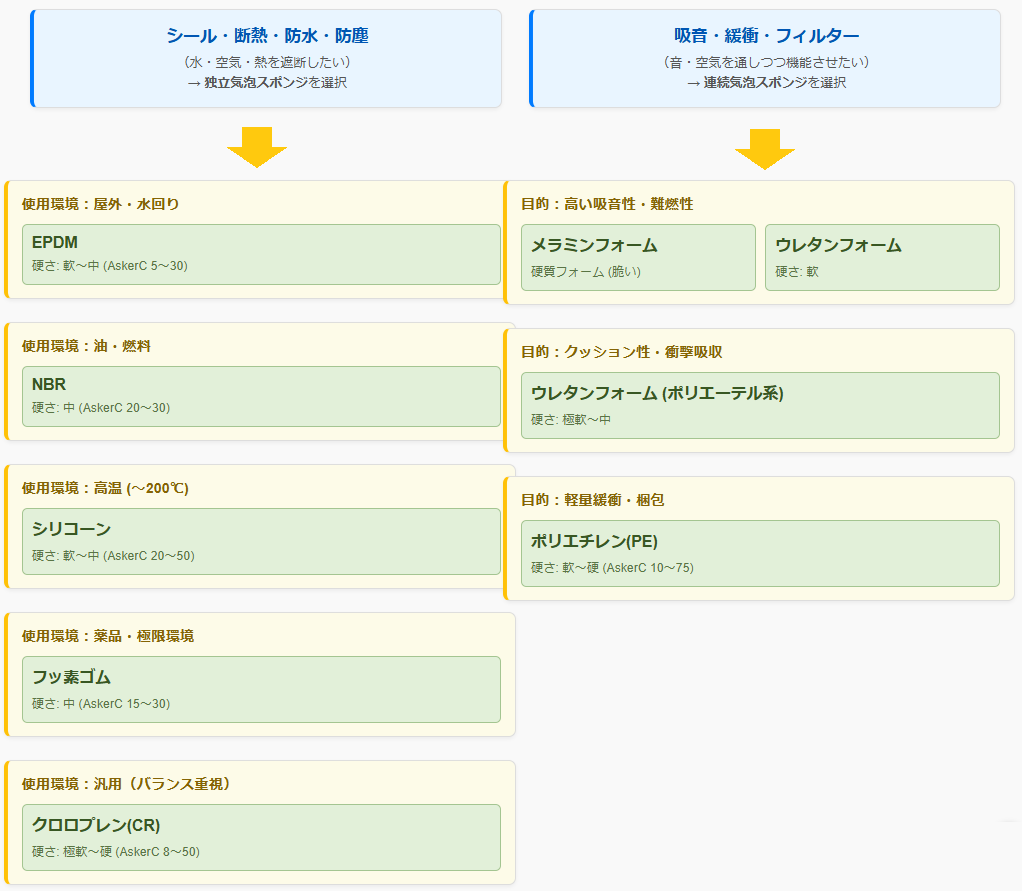
Processing method for each sponge material
When sponges are used as machine parts, in many cases we purchase the material in sheet or block form and process it into the required shape. Here we explain the typical processing methods and points to consider when selecting a supplier.
Features of Thompson processing (punching)
Thomson processing is a processing method that uses a wooden die with a blade called a "biku-die" to punch out sponges with a press machine. It is. It is easy to understand if you imagine the die cutting of cookies.
The greatest advantages of this method are its high productivity and low cost. Once a mold is made, products of the same shape can be produced in large quantities at high speed, making this method very suitable for mass production.
On the other hand, there are some disadvantages. First, there is an initial cost (mold cost) to create the blade mold. Also, because the blade pushes through the soft sponge, the cut surface may be slightly tilted inward (sagging) or compressed. For this reason, it may not be suitable for parts that require extremely high dimensional accuracy.
Advantages of Water Jet Processing
Waterjet processing is a processing method in which ultra-high-pressure water is injected through a thin nozzle and the force of the jet cuts the material. It is.
The greatest advantage of this process is that it is a "non-contact, non-heat process" that does not apply any physical pressure to the material and is not affected by heat. This eliminates compression and deformation of the cut surface, which tends to occur in Thomson processing, and produces a very clean finish. In addition, because processing can be performed directly from CAD data, dies are not required, and the system can quickly accommodate prototypes of complex shapes and one-of-a-kind products.
However, processing speed is generally slower and costs tend to be higher than Thomson processing. Also, when processing thicker materials, the possibility of a slightly tapered (slanted) cut surface due to the spreading of the water jet must be considered.
Why cutting is not common
Cutting processes using machining centers, etc., which are commonly used for processing metals and hard plastics, are rarely used for sponge materials. The reason for this is the "elasticity" and "softness" unique to sponges.
When a blade such as an end mill rotating at high speed makes contact, the sponge is not scraped cleanly like a hard material, but is greatly deformed as if it is escaping from the blade. As a result, the cutter plucks the material, resulting not only in dimensional accuracy, but also in the cut surface becoming fluffed up and torn.
In addition, plucked sponge fragments can become entangled in the blade, making it impossible to continue processing. Thus,Cutting principles are fundamentally incompatible with sponge materials, which are prone to elastic deformation, and are therefore not an option It is a
Slicing and Other Methods
Slicing is a processing method to cut out a sheet of a specified thickness from a large block (van) of sponge. It is. It is processed like slicing a loaf of bread using a machine similar to a band saw. This is an important process that determines the thickness of the final product and requires high thickness accuracy.
Other methods include cutting with a cutting plotter that moves the blade based on CAD data and laser processing. However,Laser processing uses heat to melt and cut materials, so be aware that some types of sponges may melt, harden, or discolor the cut surface. It is.
Points to consider when selecting a processor
In order to obtain the best sponge parts, it is extremely important to choose the right processor. Not only "can they cut" but also "do they understand the characteristics of the material" is a major factor.
A good processor will be familiar with the characteristics of each sponge material (hardness, restorative properties, effect on heat, etc.) and will suggest the most suitable processing method and conditions for that material. Another important selection criterion is their ability to handle prototypes and their management system that guarantees stable quality. Get quotes from multiple suppliers,You should also determine if they are available for technical consultation. I am sure you will.
How to install each sponge
The method of attaching the processed sponge as a component is also an important factor in the design. Four typical mounting methods are introduced below.
Use of sponge with adhesive tape
The easiest and most common method is to use a product with double-sided adhesive tape attached to one side of the spongeIt is Since it can be fixed simply by peeling off the release paper and sticking it on, it is extremely easy to work with and greatly contributes to simplifying the assembly process.
What is important in this method is the compatibility between the type of adhesive tape and the material to which it is attached (adherend). There are various types of adhesives, such as acrylic and rubber-based adhesives, each of which has different strengths in the material to which it is attached and the environment in which it is used (temperature, humidity, etc.). In addition, when attaching to materials with low surface energy, such as plastics, primer treatment may be necessary to improve adhesion.Choose products with adhesive tape, provided by the material manufacturer or processor, to be sure It is.
Adhesive fixation and precautions
Fixing with adhesives for complex three-dimensional shapes where adhesive tape cannot be used or where stronger adhesive strength is required. I will do so.
WHEREAS.The most important thing to note is the chemical compatibility of the adhesive with the sponge material It is. For example, common adhesives rarely stick to silicone sponges. Special silicone-based adhesives must be used. Similarly, polyethylene foam and other materials are known as difficult-to-bond materials, for which dedicated primers and adhesives are essential.
If the wrong adhesive is chosen, not only will it not adhere at all, but it may also melt or alter the sponge.Be sure to check the combination recommended by the sponge manufacturer or adhesive manufacturer before use.
Mechanical fixation with screws and collars
Mechanical fastening with screws is effective when installing sponges more securely and in locations where they may be repeatedly attached and detached.It is. However, if the soft sponge is tightened directly with screws, the sponge will be too crushed to provide adequate fixation force.
A tubular metal or hard plastic component called a "collar" is used for this purpose. First, a hole is drilled in the sponge through which the screw passes, and the collar is inserted into the hole. Then, screws are inserted into the collar and fastened. In this way, the hard collar receives the tightening force of the screw and prevents the sponge body from being compressed more than necessary. This allows the sponge to maintain stable installation for a long period of time and prevents the sponge from becoming worn out.
Mounting by fitting (press-fitting)
This method is to fix the sponge by fitting it into a groove on the enclosure or frame without using adhesives or tapes. Because no adhesive is used,Suitable for applications that require a clean environment or for parts that may need to be replaced later.
The key to the success of this method is in the groove design. Design the groove to be slightly narrower than the width of the sponge, so that the sponge is held in place by its own repulsive force (compressive stress). The calculation of this "compression ratio" is very important. If the compression ratio is too low, the sponge will fall off. On the other hand, if the compression ratio is too high, the sponge will be overloaded, causing it to wear out prematurely and making installation difficult.
The groove should be designed to achieve an appropriate compression ratio (generally around 20-401 TP3T), taking into account the hardness and resilience of the sponge.
Summary: All knowledge for optimal sponge selection
As we have seen so far,Selecting the best industrial sponge requires multiple perspectivesIt is. The following is a summary of the key points of the selection process to help you find the only option that meets your objectives among the myriad types of sponges available.
- First, decide the cell structure based on the general application, such as sealing or sound absorption.
- Independent bubbles are suitable for sealing and insulating applications that block water and air
- Continuous bubbles are suitable for sound absorption and filtering applications that allow sound and air to pass through
- Then refine the base polymer from the environment of use
- Weather-resistant EPDM is the first choice for outdoor and water environments
- NBR, which specializes in oil resistance, is best suited for environments where it comes in contact with oil and fuel.
- CR is a candidate if you want a good balance of a wide range of performance.
- Select heat-resistant silicone for high-temperature environments above 100°C
- Consider FKM (fluoro rubber) for extreme environments exceeding 200°C
- PE foam is effective if lightweight and shock-absorbing properties are required
- If high sound absorption and flame retardancy are required, melamine foam will work.
- Understand the difference between polyester-based and polyether-based polyurethane foam.
- Hardness (Asker C) is selected based on the balance between tracking and resilience.
- Small compression set is essential for long-term sealing
- Select materials with appropriate mechanical strength for the physical load
- If safety is required, check for UL standards or other flame retardant properties.
- Consider Thomson for mass production and waterjet for accuracy.
- Mounting methods include tape for ease of use, adhesive for strength, and fitting or screw fixation with collar for interchangeability.
That's it.