Today, we are going to discuss the "What is the spring constant? Why spring constants vary and tips to suppress variation.Here is a note about "TheThe following is a summary of the basic concept of spring constants and points to note when setting spring constants, which come into play when designing compression springs.
- Spring (compression spring)
- What is a spring constant?
- First, a basic story about reducing spring variation
- I think the most important part of spring design is to set the "load" at the "specified height", not just designing spring constants.
- The spring constant is only the result of an assumed calculation; in reality, it should be adjusted to suit the purpose.
Spring (compression spring)
What is a spring constant?
What is spring constant?Proportionality constant obtained by dividing the load applied to a spring by its extension (contraction) In,The larger the wire diameter of the spring, the larger the spring constant, and the larger the number of coils or the average diameter of the coil, the smaller the spring constant. It will be.
Related expressions for spring constants
Spring constant = applied load / amount of elongation (contraction)
Load = Amount of elongation (contraction) x spring constant
First, a basic story about reducing spring variation
Generally, when a pressing force of about 10% of an existing spring is to be obtained, the method of adjusting the overall length (set length) is taken rather than purchasing a new spring. However, if the spring constant is changed unnecessarily, a problem may occur.
The figure above shows thatThere are three types of springs that can provide a pushing force of 100 N at the reference position.
The pressing force is the same for all of them, but the spring constant is different, so the pressing force changes as the height (set length) changes.If the pressing force is close to the target value (ambiguous), any spring constant can be used, but if multiple springs are used or if the pressing force is to be set severely, the change or variation in the spring constant will be twice as large as the number of springs, so care must be taken in setting the spring constant. It is.
Therefore, when a machine designer designs a spring to be used in a machine, it is recommended that the spring be designed with a low spring constant per target value to minimize variation and ensure a stable design.
However, since designing springs requires a bit of familiarity, many people use purchased products sold by spring manufacturers. The basic idea is the same at this time, and I think it is best to select the outer diameter and set length, and among them, the one with the lowest spring constant, as it is in the direction that allows for processing errors.
I think the most important part of spring design is to set the "load" at the "specified height", not just designing spring constants.
This is because, as an incorrect design methodIf the pressing force at the specified height is not indicated, the spring constant changes quite a bit. I know, right?
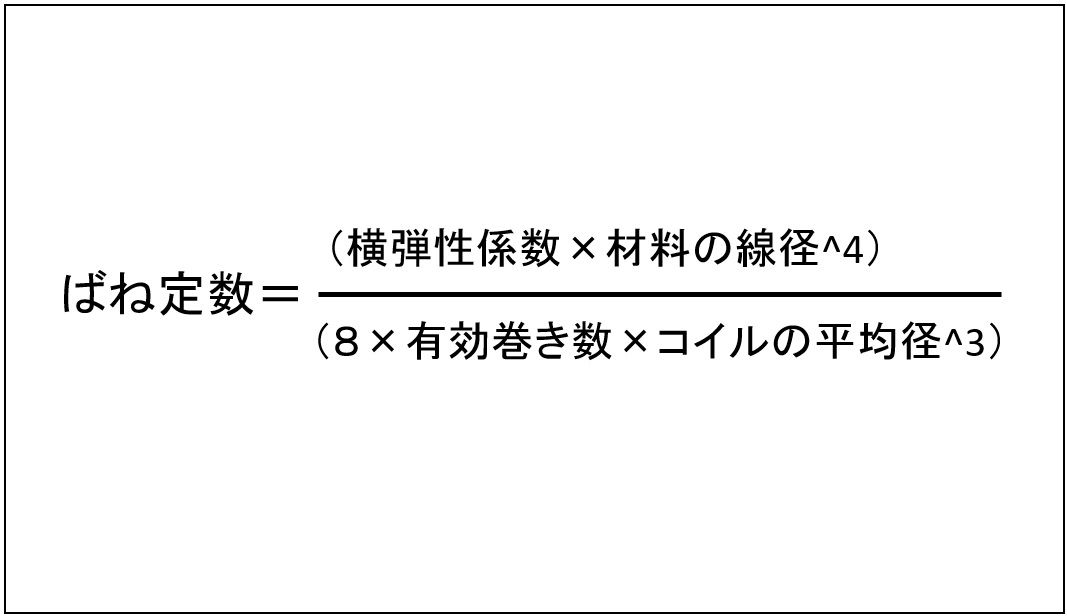
The calculation of the spring constant is as follows
If you look at the formula for this spring constant, you will notice, for example, that the calculation is based on the following information
- Wire diameter of material : 0.5mm
- Average coil diameter: 2.3 mm
- Number of effective coils : 8 coils
- Modulus of transverse elasticity: 78500 N/mm2
In the above case, the spring constant is found to be
However, in the end, considering the tolerances of the materials used (manufacturing errors and variations in wire diameter)
This means that the spring constants will be very different in the calculation.If the difference in spring constants is twice as large as the number of books, it is unlikely that the target value can be aimed at.
*The dimensional tolerance of wire diameter of material SWPB0.5 is "+0.005" within the range of "±0.008" in JIS, if it has been made.
*If the average diameter tolerance is set to "±0.15" and the product is made at "-0.1".
The spring constant is only the result of an assumed calculation; in reality, it should be adjusted to suit the purpose.
Thus, you can see that the spring constant must be managed a little more carefully.
Spring constants are calculated values only It is. In fact, we have a spring manufacturer.If the "load value at the specified height" is indicated and it is an "average diameter" or if there are variations in wire diameter, the tension must be inspected and "adjusted" during production.
This is the solution.
Supplement: Spring manufacturer's concept of "load value at specified height".
As you can see, you specify the specified height and the load value at that height, but how accurate is the load value made to be? The question was asked, "How accurate are the load values made?Where we spoke to the pring manufacturer,
A tolerance of ±10% of the load at the specified height is appreciated by the manufacturer, but a tolerance of ±5% of the load at the specified height may be required when load accuracy is required. Yes, I would say so. After all, the looser the tolerance, the better. I think it would be a good idea to make a thorough calculation on the design side and produce springs with the loosest possible tolerances.
That's it.
RELATED:Spring