Today, we are going to discuss the "Mechanical and conceptual design methods that create 1 from 0Here is a note on the "What is the best way to get the most out of your time?
First, a definition of conceptual design in this articleI note that theA (the customer) asks B (the designer) to design a new machine from scratch to produce a part named C. The mechanical designer should do the conceptual design. and assume that
This work is more specific than the conceptual design work found in books and on the web.
I do conceptual design, and sometimes I am asked to do conceptual design.Mechanical design is aSome designs take several months to design, so the starting point, the conceptual design, is very important. So,There is basically no manual for conceptual design, which requires experience I believe that this is an artifact of the know-how that each designer has learned from practice since the
In other words, the results will vary greatly depending on the environment in which the designer was raised. Just because you're a designer doesn't mean you can do everything. So,I amI think there are very few people who can correctly put a concept into CAD. I feel that it is a good idea.Design is something that needs to be done However, the actual timing for conceptual design is only a few times a year, and even if multiple people like myself are designing, the number of 0 to 1 new designs is about 10 units per year.
So today.Deliverables required for conceptual design The conceptual design method and concept are clarified while clarifying theI will try to express it in my own words.
In this section, we will also take notes on conceptual design methods, mainly for production facilities.

- Conceptual Design Methodology
- Finally.
Conceptual Design Methodology
Let us explain one by one.
Basic Concept
To begin with.No list required for conceptual design deliverables. I will tell you that this is the case.If you are asked to do a concept like this one,All the things that customers want now and will want in the future are necessary deliverables. will be.
The target specifications for the conception may be summarized in a textual document, such as a specification, or you may receive an image drawing as an attachment. However, these are specification requirements, and the designer must transform them into a feasible structure.
Many specifications lack information. But that is inevitable, and some specifications will change as they are converted into a realistic structure by the designer, so the following two items are actually repeated in the process.
- Based on the initial information, the designer drafts a specific plan.
- Based on that plan, specifications are evaluated and details of specifications are determined (DR)
- repeat
We understand the feeling of the designer who says, "I can't do it unless the specifications are set," but we also understand the feeling of the user who says, "I want to decide on the specifications as I look at them. In other words, the key points in this conceptual design areNot all, but to determine specifications on the designer's side, it is necessary to make decisions one way or the other (to create a tapping board). The first two are the following.
Below,The following is a summary of the conceptual design procedure when the information necessary for conceptual design (simple specifications and image drawings) has already been received to some extent.
- Tentatively determine work posture and arrangement (layout)
- Tentatively calculate tact time for all processes with assumed equipment (create time chart)
- Put in equipment and make modifications to the work layout to make it feasible.
- Draw only important points in detail.
- draw up a plan
Thus, the basic flow is as described above. I will explain in a little more detail.
(1) Tentatively determine work posture and placement (layout)
After reading the specifications, the first thing to do in the conception is toTo tentatively determine the posture and placement of the workIt is.
The shape, orientation, and direction of the workpiece change during each process, whether machining or assembling, so the temporary layout of the workpiece must be done first.
(2) Tentatively calculate tact time for all processes with assumed equipment (create a time chart)
Next, based on the production time per unit that has been determined as a specification, the time required for those processes is allocated toCreate a time chartWe will continue to do so.
At this point, calculations are made with the equipment to be used in the facility (which may be assumed at this time) to determine a realistic production process. The documents we create here are Materials to answer the first time whether the customer's request is feasible, and then monitor it until the end of the project. The first two are the following.
Basically,Tact can be tentatively calculated if the target production volume per hour and the time required for each work process are known. It is.
And if we could make a sheet that shows everything such as acceleration, distance traveled, waiting time, time involved with sensors, etc. as shown below,You can also answer whether the conditions you gave at the beginning of the design process are reasonable values.
Tact calculation is the safest way to create a machine that is the safest way to create a process that can be reasonably accomplished at a typical speed.For example, it is a good idea to quantify the plan for lifting after chucking, such as lifting slowly.
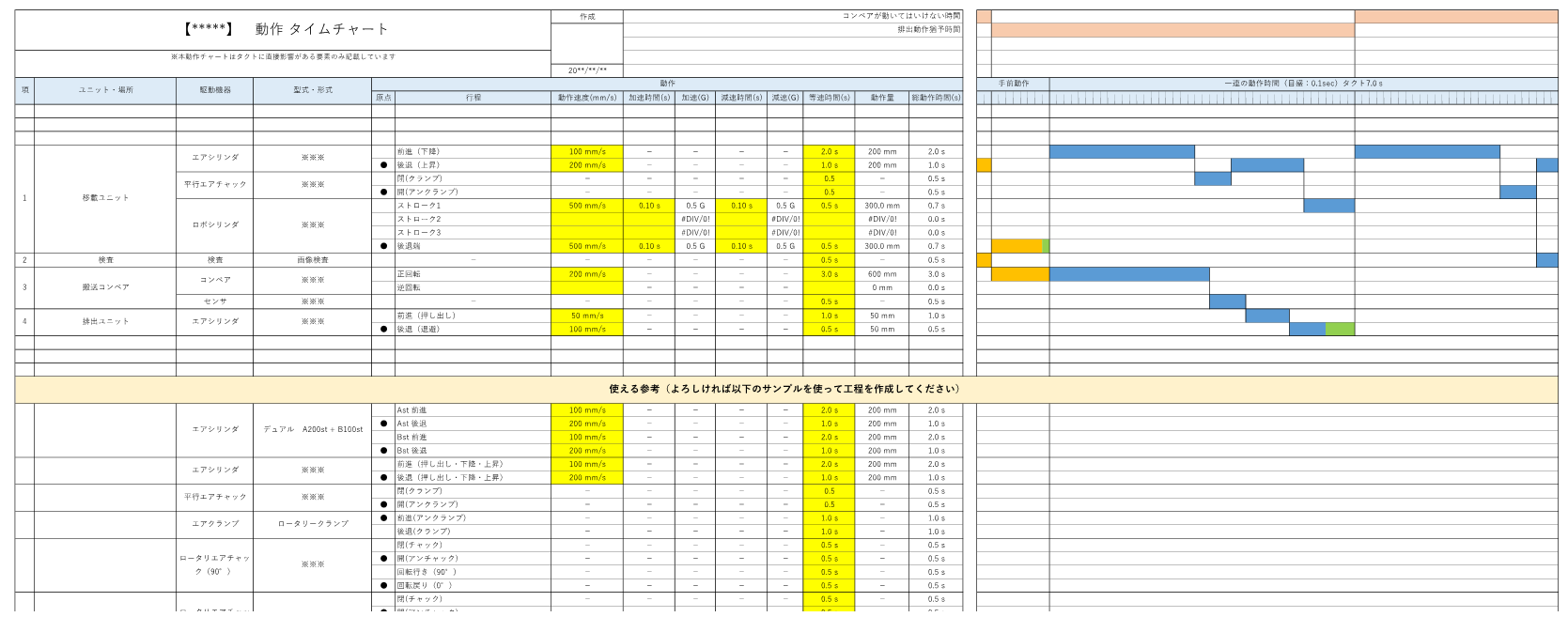
And once, as a progress report.Do you want to report that you plan to go ahead with this, or do you want the customer to confirm this? It is a good idea to clearly contact the company to confirm the underlying origins of the project.
(iii) Put in equipment and modify the work layout to make it feasible.
The next step is to modify the layout by adding purchased items (equipment) that will be formed based on the tact calculation.At this time, we are aware of the followingEven if the tact calculation shows a feasible value, it may be necessary to redo the tact calculation when the layout is done. So, repeat steps (2) and (3).
Supplement 1 Reasons for layout and recalculating tact
In selecting equipment such as actuators, it becomes necessary to change the actuator size as the degree of load application (e.g., the position at which the load is applied) changes. If the tact is strict, it is necessary to use a moment-resistant actuator for power transfer, but if there is room for tact or if the cost advantage is high, a modest drive can be used, and it is necessary to recalculate to come to a compromise between the two.
Supplement 2 Additional items to be included in the layout
At this point, there are items that should be added to the layout.
- Image of equipment trestle and foundation structure
- Equipment peripherals (controller for robots, cave bearers for moving parts, etc.)
- Guard image (with clear components and clear interlocks)
- Operator (human model), operation panel, indicator lights, etc.
It is.
These are the parts of the DR story that are new customers.We don't know how much conceptualization is needed or what we want to make sure we are looking at from the user's unique perspective. Since there are some things that need to be done, it would be good to include items here in the layout that do not need to be rushed, but for which a temporary response is desired.
(4) Draw only important points in detail.
Next, only the important points are considered in detail.
Tact calculations are satisfactory,It's still too early to think we can go there because the layout is so well done. It is.The key to making them happen is,Partially detailed design. It is.
In this conceptual designIt is important to clarify how the subject work is to be handled. The material of the part in contact with the workpiece, the gap before and after the chuck, the pressing allowance, and other important parts are clarified in TheSecond, it is designed with positioning and maintenance in mind.At this point, it is important to consider whether or not tools can fit, whether or not parts can be easily replaced, and whether or not the design allows for quick response by replacing each unit when a problem occurs. It is.
And,At this point, you're starting to see the big picture of that machine. In other words.This is the conceptual design I believe it is.
thereforeThe conceptual design does not require detailed modeling if it is possible to imagine the completion of these projects,Modeling the important parts This is the completion of the project.
(5) Drawing
The last step is to make drawings.The reason for making drawings,Drawings are needed to visualize the concept and to add additional information to take it to the next step. That is why.
It is best to express in drawings what has been conceived, what cannot be seen in the model's stand-alone information or the assembly's surface geometry alone.
Of course, it is quite possible that users do not have access to CAD data,Insufficient is fine,Even a flaw is better than no flaw.Therefore, we urge you to consider even the creation of drawings that allow you to look at the project from a bird's eye view as part of the conceptual design process.
[Digression.
As a side note, there are some movements that do not require drawings with "assembly inspection drawings", which is a model check that sounds like it,There are many important things that disappear along with the drawings (areas where efficiency is reduced by the loss of drawings). So, I value drawings tremendously.
Finally.
Conceptual design is a task with a great deal of work to do.Honestly, experience is necessary. I think it is. Experience makes it moreIt becomes possible to design realistically. How to structure that realism is the difficult part of conceptual design, and I think that is where differentiation arises.
*This is just my personal opinion, and while there are some differences in the deliverables depending on the category you are designing for, I thought I would note some basic ideas.
That's it.