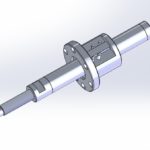
Here are the options when using a ball screwDifference between Rolled Ball Screws and Precision Ball Screws Here is a note about the
When searching online for the difference between rolled ball screws and precision ball screws, many articles only provide superficial comparisons of specifications. However, on actual mechanical design sites, clear judgment criteria based on mechanical principles such as life calculation and buckling load are required, not just differences in accuracy. Based on my design experience, having worked on numerous automated machines, and thoroughly scrutinizing the latest JIS B 1192 standards and technical data from various manufacturers, I have organized the information that designers truly need into a single flow.
This article will first explain in detail the clear differences in precision and performance resulting from manufacturing method variations. We will then comprehensively guide you through the product selection process from a practical, on-site perspective, taking into account cost and delivery time.
Whether you are just starting your design or are a veteran struggling with selection, reading this article to the end will give you the solid knowledge to choose the optimal machine element.
Difference between rolled ball screws and precision ball screws, and their basic structures
Definition of grades according to JIS B 1192 standard
When discussing the quality of ball screws, one cannot avoid mentioning the Japanese Industrial Standards.JIS B 1192is its existence. This standard finely regulates the precision grade that represents the accuracy of screw lead, and designers determine specifications using this grade as a common language. Generally, grades from C0 to C10 are set.The smaller the number, the narrower the margin of error and the higher the precision.indicates that it is.
Many manufacturers offer C0 to C5 as precision grade and C7 to C10 as commercial grade (for transport).For example, when micron-level control is required, as with machine tools, Class C3 or higher is often selected. On the other hand, for conveyors that only move workpieces within a certain range, Class C7 is usually sufficient.
In this way, understanding the standard grades is the first step to ensuring necessary performance while avoiding excessive specifications.
Differences in manufacturing methods between grinding and cold rolling
The manufacturing process difference in how the screw shaft is molded is the key factor that fundamentally separates product performance.Many precision specifications are achieved through a grinding finishing method, where steel that has been hardened by heat treatment is abraded with a grinding wheel.It is made by. This method is very labor-intensive, but its characteristic is that it can form extremely accurate groove shapes while eliminating the effects of thermal distortion.
Contrast,The rolling specifications adopt a cold rolling process, which shapes grooves by applying strong pressure while rotating a round bar.This method utilizes plastic deformation, boasting overwhelmingly high productivity that allows for the mass production of shafts in a short period.
Further,The rolled surface is finished to a smooth, mirror-like surface with a hardness of 250HV or higher due to work hardening, providing the hidden benefit of excellent wear resistance.It also exists. However, in terms of high-precision positioning capabilities, it falls short of grinding and finishing.
Lead accuracy, which influences positioning accuracy
The most important metric in design is the accuracy of the amount of movement when a screw is rotated one time.Lead accuracy It is.
In JIS standards, permissible values are defined for items such as representative travel error and fluctuation. In the precision class, cumulative error over the entire stroke is strictly controlled, minimizing deviation from the target position even over long travel distances.
In one rolling specification, accuracy is generally managed primarily by the movement error per 300mm (variation V300). For C7 grade, an allowable error of about 0.05mm per 300mm is permitted, which can be considered a sufficient value for general conveying equipment.
However, in advanced equipment that synchronizes and moves multiple axes, this slight error can accumulate and potentially cause malfunctions. For this reason,It is important to preemptively calculate the absolute stopping accuracy required by the device and select the appropriate grade.
"Variation" refers to the maximum range of actual movement (the difference between the maximum and minimum values) within any 300mm screw length.
Comparison Table of Precision Grades Based on JIS B 1192
| distinguish | Accuracy Class | Main manufacturing method | Lead accuracy management standards | Main Features |
|---|---|---|---|---|
| For precision (for positioning) | C0, C1, C3, C5 | Grinding finish | Strict management through linearity and directionality | High precision and high rigidity, but high price |
| For transport | C7, C10 | Cold rolling | 300mm travel with a positional error regulation | Low cost, short delivery time, but accuracy is limited |
Reference source: THK Co., Ltd.https://www.thk.com/jp/ja/products/ball_screw/selection/0002/)
Different applications for positioning and conveying
To effectively use a ball screw, you need to clearly distinguish between its two roles: positioning and conveying.For positioning, the primary mission is not just to move, but to "stop precisely at the intended position." Therefore, as will be described later,The operation assumes the elimination of internal gaps and high rigidity through preload.will be.
On the other hand, conveyance applications aim to transport goods smoothly while controlling costs. These typically have a slight axial clearance, but if movement is in a fixed direction, the backlash can be minimized. For instance, in drive mechanisms for medical equipment or amusement machines, where extreme precision is not required, rolled ball screws for conveyance would be the optimal solution in terms of cost performance.
Rolling Ball Screw vs. Precision Ball Screw: Differences and Performance Indicators
Double nut to ensure preload and rigidity
Mechanisms to unleash the high potential of precision ball screwsPreloadThis is. The double nut method, which uses two nuts in combination, is a standard technique for achieving high rigidity. By inserting a spacer between the two nuts and applying an internal load in advance, the gap between the balls and the grooves is kept at zero or even negative.
If this state can be maintained, the nut will be less likely to deform even under significant external load, achieving very stable operation.Since rolled ball screws are basically operated with a single nut, this level of high rigidity cannot be expected.Therefore, in tough environments with heavy workloads requiring high-speed acceleration and deceleration, it is advisable to select precision specifications that allow for preload management with double nuts.
The impact of backlash on operation
In mechanical design, backlash is the biggest enemy hindering the accuracy of reciprocating motion. This refers to the physical play between the screw shaft and nut, which causes temporary idling (lost motion) when the direction of rotation changes. When preload is applied to precision ball screws, this play is eliminated, allowing for immediate response even during reversal and demonstrating high responsiveness.
In contrast,General rolled ball screws have a clearance of a few microns to tens of microns.When used with precision machining equipment, etc., this can cause shape distortion during operations like arc interpolation.
However, recently, there are also products using rolling that have adjusted the ball diameter to reduce the clearance. Since rolling can sufficiently handle certain situations if the application is limited, please check the "axial clearance" item in the catalog carefully.
Selection procedure for differences between rolled ball screws and precision ball screws
Design decisions prioritizing cost and short delivery times
In actual projects, cost and delivery time are just as important as performance and cannot be ignored. Ball screw rolling can reduce prices to one-fifth or even one-tenth of that of ground finishing in some cases, making it an essential component for cost reduction in mass production equipment.
Additionally, manufacturers often stock these as standard items, making them so readily available that they can be shipped out the same day an order is placed.
In contrast, for precision specifications, many items are made-to-order, so it's not uncommon for delivery to take several months. If it's determined in the early design stages that high precision is required, it's necessary to either proceed with arrangements immediately or devise a way to design it so that it can be substituted with rolling specifications.
Thus, balancing technical expertise with business agility is where a professional designer's skill truly shines.
The Key Principles of Dust and Lubrication Management to Prevent Trouble
No matter how expensive a ball screw you choose, if you neglect its subsequent maintenance, you won't be able to achieve its full lifespan.
Foreign matter contamination is particularly critical. If chips or dust enter the nut, it will interfere with the circulation of the balls, leading to rapid damage.When using in harsh environments, always design to cover the entire shaft with bellows or protective covers.
Maintaining lubricants and greases is equally important. Since metal parts repeatedly roll and come into contact with each other forcefully, wear progresses rapidly when the oil film breaks down.
Manual lubrication is often overlooked, so measures such as installing automatic lubrication units or attaching lubrication units that do not require lubrication for extended periods are recommended. By continuing proper protection and lubrication, I believe ball screws will maintain their high precision for many years.
Summary of the differences between cold-formed ball screws and precision ball screws
Here are the key points for choosing between rolled ball screws and precision ground ball screws.
- Precision ball screws can achieve nanometer-level accuracy through grinding and finishing after heat treatment.
- Rolled ball screws boast outstanding productivity through the cold rolling process with plastic deformation.
- JIS B 1192 accuracy classes C0 to C5 have strict control standards for positioning.
- Standard classes like C7 and C10 excel in cost-performance, primarily for transport applications.
- The difference in lead accuracy directly leads to cumulative error in the device, so it is necessary to calculate backward from the design targets.
- The precision specifications allow for preloading with double nuts, completely eliminating backlash.
- Screw rolling specifications have structural gaps and are therefore suitable for unidirectional feed or low load applications.
- In life calculations, load factors that consider vibration are used in addition to the basic dynamic load rating and actual load.
- To ensure the design life is achieved, scrutinizing the expected mileage calculated from average load is important.
- You must perform calculations for shaft diameter and support span to prevent resonance due to critical speed.
- Thorough safety design to prevent shaft bending accidents by checking the buckling load
- The closer the terminal support conditions are to fixed, the wider the permissible range of rotational speed and load.
- From the perspectives of cost and delivery time, rolling specifications with ample inventory are overwhelmingly advantageous.
- Consider a design that combines correction with external scales to avoid over-quality.
- For a longer service life, dust prevention with bellows and proper grease supply are essential.
- Rolled ball screws vs. precision ball screws: Understand the differences correctly and select the optimal machine elements.
That's it.
-

-
Various calculations for ball screws
This section summarizes various calculations, usage, and concepts related to ball screws used in machines. Ball Screws Various calculations for ball screws Calculation of axial load Axial load applied when using vertical or horizontal ...
See more.