Today, we are going to discuss the "Concept of allowable rotational speed and maximum rotational speed of bearingsHere is a note about "The
- What is the allowable rotational speed of a bearing?
- Allowable rotational speed of bearings is only a guide
- Formula for determining the amount of heat generated: Q = 0.105 x (10^-6) x M x n
- (general) formula for finding the friction moment: M =μPd/2
- What is dynamic equivalent load?
- Formula for dynamic equivalent radial load: Pr = XFr + YFa
- Formula for determining dynamic equivalent axial load: Pa = Fa + 1.2Fr
- Coefficient of Friction of Bearings
- Allowable rotational speed of bearings is only a guide
- Which bearings are suitable for high-speed applications?
- If you want to increase the rotational speed of a bearing (Part 1)
- If you want to increase the rotational speed of a bearing (Part 2)
- If you want to increase the rotational speed of a bearing (Part 3)
What is the allowable rotational speed of a bearing?
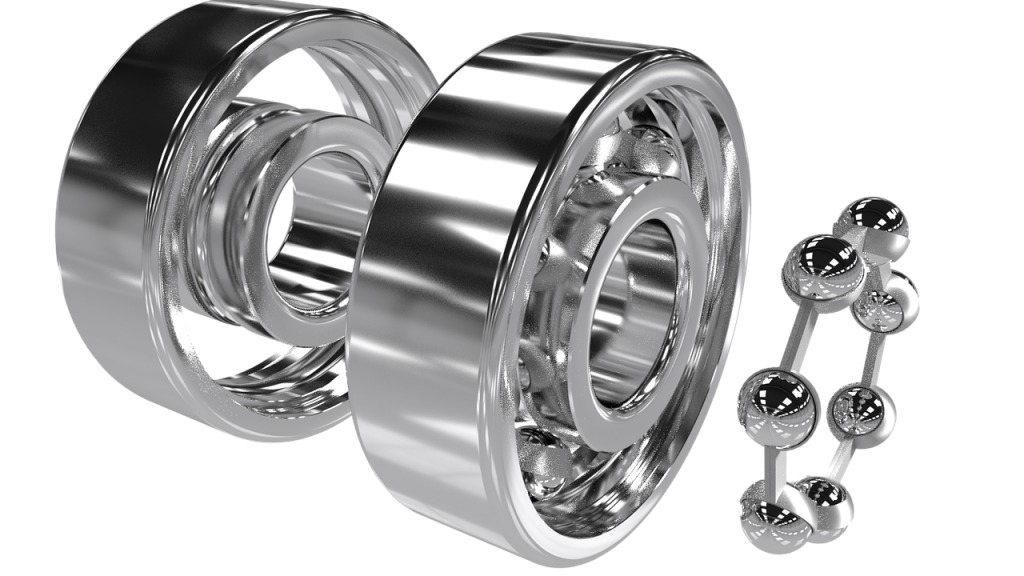
What is the "allowable rotational speed" of a bearing?The maximum rotational speed at which the machine can be operated without generating more heat than the limit.It is. The limit is set because the frictional heat generated inside the bearing causes the temperature to rise, resulting in damage such as seizure, which makes it impossible for the bearing to continue stable operation.
Allowable rotational speed of bearings is only a guide
The allowable rotational speed of a bearing is listed as a "reference value" in the dimension table in the catalog, and the calculation formula for the "heat generation rate" of a bearing is also included, so it is easy to consider. However, the moment load applied to the bearing, mounting errors, insufficient internal clearance, or excessive preload can cause abnormal heat generation. Excessive or insufficient lubricant due to lack of maintenance can also cause heat generation.
And the allowable rotational speed is based on the preconditions that "bearings with appropriate internal clearance are properly installed," "lubricants are used and properly replenished and replaced," and "normal operating temperatures under normal operating conditions.
Formula for determining the amount of heat generated: Q = 0.105 x (10^-6) x M x n
Q: Amount of heat generated kW
M: Friction moment N・mm
n: Bearing rotation speed min-1
(general) formula for finding the friction moment: M =μPd/2
M = Friction moment Nmm
μ = coefficient of friction of bearing
P = dynamic equivalent load N
d = bearing bore mm
What is dynamic equivalent load?
When both radial and axial loads act on the bearing simultaneously, but not the actual load,with themGive the same life expectancyActing at the center of a bearing such as a bearingるvirtual loadis called dynamic equivalent load.Radial bearings are subjected to pure radial loads, while thrust bearings are subjected to pure axial loads.The dynamic equivalent radial load and the dynamic equivalent radial load are expressed as "dynamic equivalent radial load" and "dynamic equivalent radial load", respectively.It is called "axial load".
Formula for dynamic equivalent radial load: Pr = XFr + YFa
Pr: Dynamic equivalent radial load N
Fr: Radial load N
Fa: Axial load N
X : Radial load coefficient
Y : Axial load coefficient
Formula for determining dynamic equivalent axial load: Pa = Fa + 1.2Fr
Pa: dynamic equivalent axial load N
Fa: Axial load N
Fr: Radial load N
*Fr/Fa ≤ 0.55 is required.
Coefficient of Friction of Bearings
Bearing coefficients of friction are listed based on the results of research conducted with multiple bearing manufacturers. Please note that the bearing friction coefficients shown here are generally used friction coefficients and may vary depending on the condition of the bearing.
- Deep groove ball bearings: 0.0015
- Angular (single row): 0.002
- Angular (double row): 0.0025
- Self-aligning balls: 0.001
- Cylindrical rollers (with cage): 0.001
- Cylindrical rollers (full roller type): 0.002
- Needle roller bearings: 0.003
- Tapered roller bearings: 0.0025
- Spherical roller bearings: 0.0025
- Thrust ball bearings: 0.0015
- Thrust roller bearing: 0.003
Which bearings are suitable for high-speed applications?
The types of bearings generally considered suitable for high-speed applications are deep groove ball bearings, angular contact ball bearings, and cylindrical roller bearings. Even among these bearings with their generally higher allowable speeds, there are differences in dimensions, precision, cage type, load, lubrication conditions, and cooling conditions.The definition of "high speed rotation" is different from each other, so design with a margin after understanding the allowable rotation speed of each bearing in the equipment and products to be used.The practical rotational speed exceeds the allowable rotational speed of the bearing used. If this is the case, or if it is likely to exceed the allowable rotational speed of the bearing used, consideration should be given to adopting forced circulation lubrication, jet lubrication, or atomized lubrication methods.
If you want to increase the rotational speed of a bearing (Part 1)
Sometimes it is possible to increase the rotational speed of the drive source, but it is dangerous to further increase the rotational speed due to vibration of the bearings that hold the rotation. In such cases, preloading the bearings may be the solution. Preloading increases the natural frequency of the shaft and other parts because they are constantly subjected to elastic compression at the point of contact between the rolling element and the raceway, thus enabling them to handle high speed rotation.
Please note that this rotational speed is not the same concept as the allowable rotational speed of the bearing.The allowable rotational speed of a bearing will drop if the load (preload, etc.) is too large, but if you want to increase the allowable rotational speed of the unit itself in which the bearing is incorporated, you may want to "preload" the bearing. This means that
If you want to increase the rotational speed of a bearing (Part 2)
If you wish to increase the actual rotational speed of the bearings used, use a lubrication method that reduces friction to reduce frictional resistance and make the specifications suitable for high rotational speeds.
If you want to increase the rotational speed of a bearing (Part 3)
If you want to increase the allowable rotational speed of the bearings you are using, you can increase the allowable rotational speed by using some kind of cooling device to dissipate the heat, such as a housing.
That's it.