Here."The setting range of the tightening torque for bolts."I am making a note about the
Generally, when bolt tightening torques are listed in drawings or procedures, they are not specified in a range with multiple tightening torques, but rather a fixed number. However, there may be cases where a range of bolt tightening torques is required. In that case, what is the range of bolt tightening torque to aim for?Today, I would like to make a note about the setting range of tightening torque for bolts.
In a conversation with an engineer the other day, he said, "It is important to control the tightening torque, but it is difficult to reliably grasp its axial force. He said, "That's true, there is no need to overestimate screw fastening, but you should at least know how to grasp what kind of condition the screw is actually in when it is tightened. That is what we talked about.
In the past, I worked for a company that delivered sub-assemblies that were incorporated into certain products. During that time, there was a problem with a screw that was built into the product that came off in the middle of the assembly.The assembly instructions for that subassembly stated "Tightening this screw is 00Nm". Of course, there should be no problem if it is tightened with this tightening torque.
Conversely, the tightening torque was determined, and it was ambiguous as to how much it should not deviate from that value.
The breakdown triggered a series of severe (or persistent) inquiries from customers about the quality control items (numerical values) that we had determined with good intentions.Screw fastening has many ambiguous parts, such as how to record evidence of tightening with a torque wrench, calibration requirements for such equipment, and testing to see how much the tightening torque drops to loosen the screw...etc. Screw fastening has many ambiguous parts. However, we thought it would be a good time to check if the design of screw fastening is appropriate, so we reevaluated the design from the viewpoint of design.
This will be the memo when we check the validity of the design at that time and prove that the result was simply a forgetting to tighten.
Bolt tightening torque range
To determine the range of tightening torques, first look at the figure below.
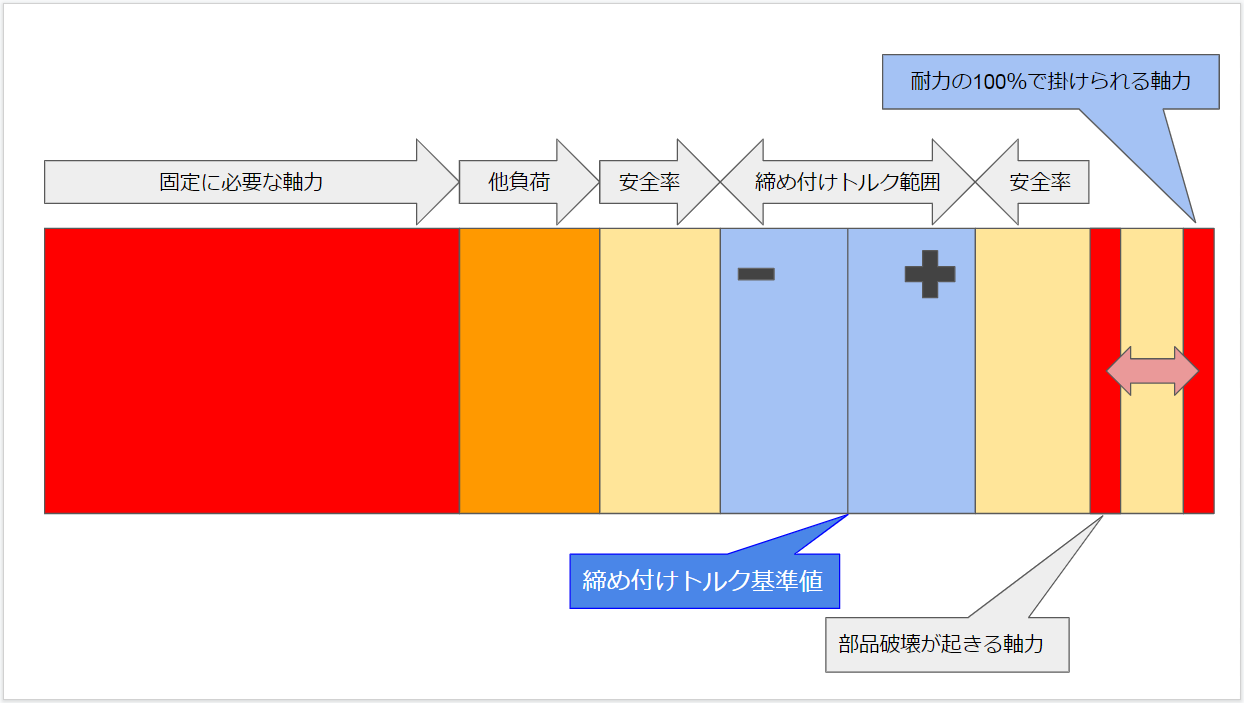
What this figure represents is the setting range of tightening torque for bolts,Basically, the figure indicates that the axial force required for fixation plus the axial force equivalent load in the use of the product and the breakage of the component due to over-tightening, or between the proof axial force and the axial force is basically good.It is.
What is component destruction?
- Excessive tightening → destruction such as sinking or deformation of fastened parts
- The tightening was proper, but...Expansion of fastening object due to mechanical heat Destruction by
What is load-bearing axial force* Load-bearing axial force is a self-explanatory name.
- Maximum axial force at the bearing capacity of the material used in the fastening
- Shallow effective engagement depth → tap destruction
- Effective engagement depth is deep → screw neck fracture, etc.
Therefore,The tightening torque at which a component breaks and the axial force to which it is subjected are interchangeable, depending on the design approach. I think it is.It is necessary to further tighten the product with a safety factor within the "allowable range" from the required torque to the limit tightening torque. In order to determine the target value.Tightening torque control andPlease try to set up your own settings.
What are the general tightening torques that are out there in various forms?
Tightening torque that is generally availableschool (e.g. of ikebana)Value for that screw It is. In design, there are various means of fastening. The designers need to know the axial force required to use bolts, what kind of screws to use after taking into account the materials that can be used in the design, and how much axial force can be obtained when the screws are tightened with the general tightening torque. If so, how many screws are needed? This is just a guideline.
Sometimes, if a bolt is designed incorrectly, the part may be destroyed when tightened with the general tightening torque for that bolt, so it is not necessarily necessary to tighten it with that torque. It all depends on the design.
Finally.
This article is my personal opinion considering my past experience and my concept of design quality, so some of you may have different ideas. I ask for your understanding.Since tightening of screws always varies, it is not a guarantee that adherence to the rule "tightening must be a fixed value of Fat Nm" = constant axial force, but rather that it is necessary to stabilize fastening quality and reduce variation as much as possible.
Especially in product design, we would like to minimize the space dominated by screws, so the use of appropriate and bolts is important.
That's it.