good day (daytime greeting)Calculating the torque needed to select a motor for a conveyor." Here is a note about the
In mechanical design (especially production equipment)Conveyors are often purchasedHowever, the selection of the conveyor requires some time and effort, including checking that it has sufficient transport capacity.
Conveyors of purchased items areEach model has a specific conveyor capacity, so it is easy to find the appropriate conveyor in the catalog. But when designing an original conveyor design, it is necessary to select a motor and calculate the torque, including the conveyor load.
This article summarizes motor calculations for conveyor transport in basic order, so please refer to it if you are selecting a motor or calculating torque for a conveyor.
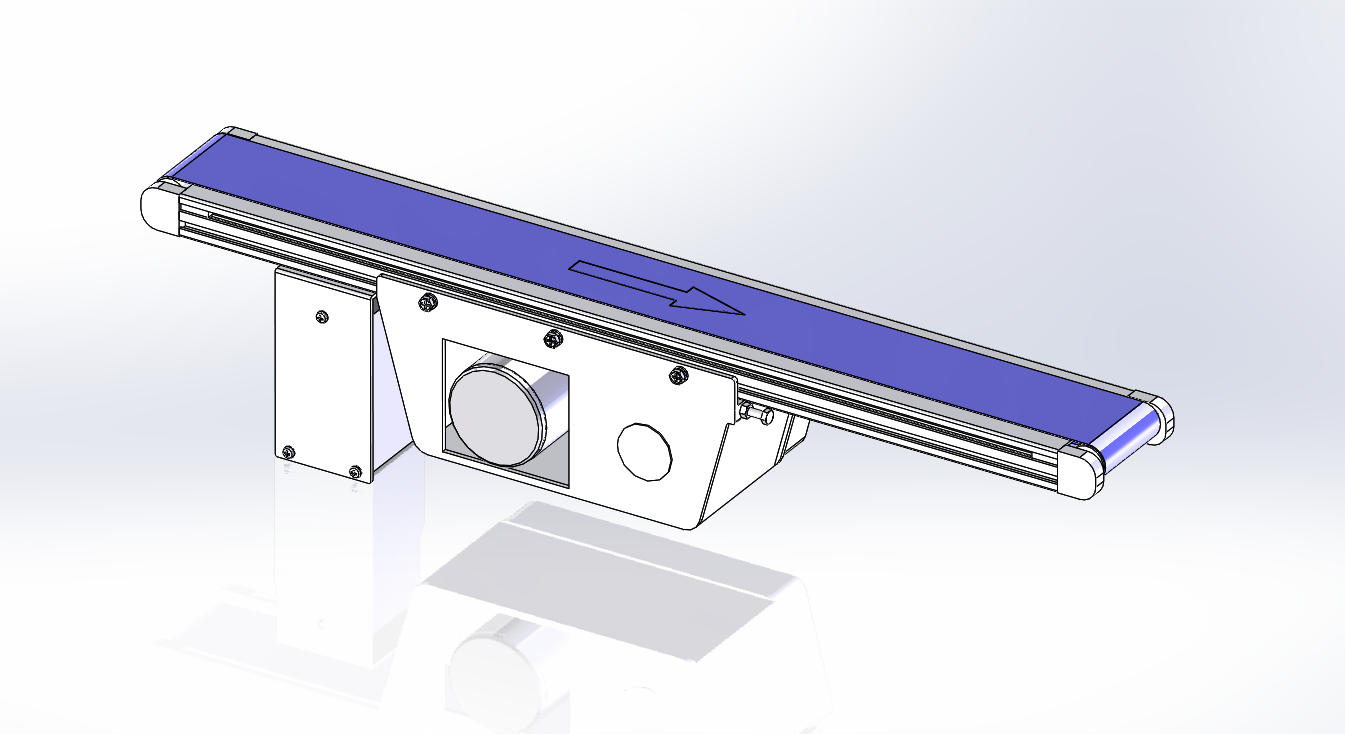
- Torque calculations required for conveyor motor selection
- (1) Decide the conveyor speed
- (2) Consider the reduction ratio of the motor that drives the conveyor.
- Approximate weight and approximate inertia of each part
- (4) Consider acceleration and deceleration times for conveyor start-up
- (5) Consider the coefficient of friction for each drive.
- (6) Multiply by the safety factor
- Conveyor motor torque calculation method and order summary
- Calculation Excel Reference
Torque calculations required for conveyor motor selection
The premise is that the purpose of a conveyor is to transport,As long as the motor torque (or capacity) and conveyor speed are correct, the basic capabilities are satisfied, The details should be optimized as the design process proceeds.
First,Initial information needed to calculate conveyor motor torqueare as follows
- Determine conveyor speed
- Consider the reduction ratio of the motor driving the conveyor
- Approximate weight and approximate inertia of each part
- Consider acceleration and deceleration times for conveyor start-up
- Consider the coefficient of friction for each drive
- multiply a safety margin by
Now, let us explain.
(1) Decide the conveyor speed
First, determine the conveyor speed first.
The conveyor speed isYou have an approximate target speed, so you may use that value tentatively. The outer diameter of the drive is required here becauseN[rpm]=transfer speed m/s*1000/(outside diameter mm*3.14)*60The reason is that the motor rotation speed cannot be reached unless the drive speed at that conveyance speed is obtained in the formula of
(2) Consider the reduction ratio of the motor that drives the conveyor.
It is also necessary to consider the reduction ratio to be given when the conveyor is turned by a motor. Since it is impossible to suddenly determine the reduction ratio, information such as the conveyor speed and the diameter of the drive unit (diameter of the reference circle) and the speed of the conveyor are also required,The reduction ratio is determined so that the basic and maximum speeds of the motor to be used are not exceeded.
Reference] Rotation speed that can be produced by a motor
- 4P of general-purpose motor 50Hz: 1500r/min
- 6P of general-purpose motor 50Hz: 1000r/min
- 4P of general-purpose motor 60Hz: 1800r/min
- 6P of general-purpose motor 60Hz: 1200r/min
- Stepping motor: Please confirm with the assumed manufacturer's product.
- Servo motor: Please confirm with the assumed manufacturer's product.
*In order to be versatile, the spreadsheet here does not calculate the reduction ratio from the rpm, but rather checks the motor rpm by changing the reduction ratio.
Approximate weight and approximate inertia of each part
From this point on, the conditions for determining the torque required for the conveyor drive motor and the capacity by converting from the torque are as follows.
The weight of the material to be conveyed and the weight of the drive components are determined, and the inertia is calculated. The inertia of the conveyor itself is then converted to the inertia applied to the motor shaft through the reducer (reduction gear).
(4) Consider acceleration and deceleration times for conveyor start-up
Deceleration time to accelerate the conveyor up to the transfer speed or to stop it is also a necessary factor in the calculation of motor torque.It is. In brief,The motor requires the most torque during acceleration.will be.
(5) Consider the coefficient of friction for each drive.
The coefficient of friction of the drive in a conveyor is generally 0.1 to 0.2It is said that This frictional force interferes with the drive of the conveyor. This must be converted to load torque and added to the required torque of the motor.
(6) Multiply by the safety factor
The above information is used to calculate the motor torque required for the conveyor, but the actual conveyor is
- How much tension is applied
- Unexpected friction.
- Reduction gear (reduction gear section) efficiency
The load torque increases due to factors such as the following, and extra drive torque may be required.
This is why we have been able to get to this point.The calculations are only the minimum required, so it is better to design with a margin of safety factorIt is.
Concept of Safety Ratio However, in the case of conveyors, there are many cases where damage to the motor does not lead to a serious accident, but rather a lack of capacity due to overload. Therefore, it is recommended that the required torque of the motor be around twice the safety factor. If you are looking at the calculations with us, you will be able to see what will happen if you change things, so it is a good idea to set the safety factor while also taking into account the characteristics of the conveyor you are designing now.
Conveyor motor torque calculation method and order summary
The following is a summary
(1) Find the attained rotational speed (conveyor speed)
N[rpm]=V*1000/(K*3.14)*60
(2) Find the motor rotation speed at the attained rotation speed (adjust the reduction ratio to the possible rotation speed)
Ns[rpm]=N*H
(iii) Find the moment of inertia that the conveyor has.
E[kg-m^2]=(1/4)*((((M2+M1)/2)+M3+M4)*(K/1000)^2
(4) Calculate the converted moment of inertia to which the motor shaft is subjected.
F[kg-m^2]=(1/H)^2*E
(5) Calculate the external load torque received by the conveyor drive shaft.
P[N-m]=(M3*9.8*μ)*(K/2/1000)
(6) Calculate the converted external load torque to which the motor shaft is subjected.
P'[N-m]=P/H
(7) Calculate angular velocity
ω Angular velocity [rad/s] = (Ns/9.55)
Calculate angular acceleration (⑧)
Alpha angular velocity [rad/s^2] = ω/G
(ix) Calculate the motor torque required for acceleration.
Torque T1[N-m]=((F+D)/9.55)*(Ns/G)+P'
(10) Calculate the motor torque required for acceleration (safety factor factored in).
Torque T2[N-m]=T1*U
(11) Calculate motor torque at constant speed
Torque T3[N-m]=((F+D)*ω)+P'
Calculate motor torque (safety factor factored) at constant speed (⑫)
Torque T4[N-m]=T3*U
⑬Find the required torque when stopping at a specified time
Torque T5[N-m]=(((F+D)*Ns)/(9.55*B))-P'
⑭Calculate the required torque (safety factor factored in) when stopping at a specified time.
Torque T6[N-m]=T5*U
(15) Calculate the motor capacity required from the motor torque at acceleration.
W[kW]=0.1047*Ns*T1/1000
⑯Find the required motor capacity (safety factor factored in) from the motor torque at acceleration.
W[kW]=0.1047*Ns*T2/1000
Based on the above calculations, try to purchase a conveyor from each manufacturer or design a conveyor.
Calculation Excel Reference
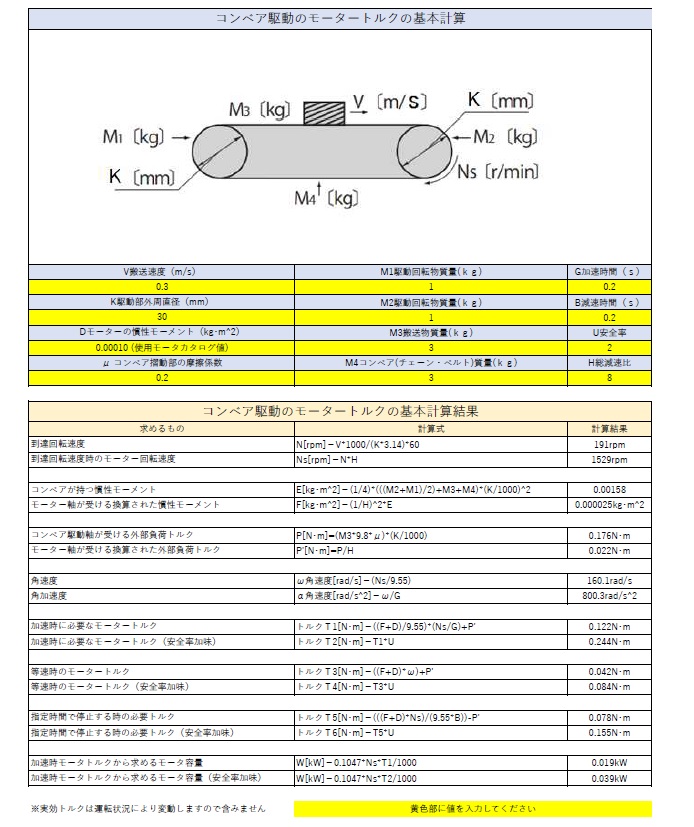
About Excel files
Thank you very much for using the above calculation excel, which many of you have used for a free period. Starting in 2024, this file will beDownload sales at BASE The following is a list of the products that are available for purchase. If you need it, please use it after purchase.
That's it.