Today, we are going to discuss the "Calculation of impact value, impact force, and load on conveyor stopperHere is a note about "The
When conveying workpieces horizontally on a conveyor or stopping a vertically falling workpiece with a stopper, the load applied is determined and the structure is designed by adding a safety factor to that value.Today, we note the following six methods of load calculation to determine how to calculate the load on these stoppers.
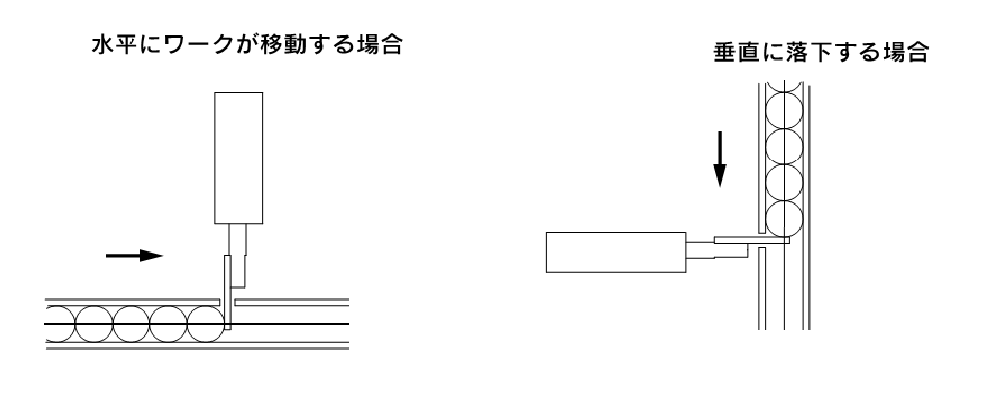
- Calculated impact value when workpiece hits stopper in horizontal transfer [G].
- Calculated impact force when workpiece hits stopper in horizontal transfer [N].
- Load [N] when workpiece is continuously applied to stopper in horizontal conveyance, constant drive, etc.
- Calculated impact value when a workpiece strikes the stopper in a vertical drop [G].
- Calculated impact force when workpiece strikes stopper in vertical drop [N].
- Load when workpiece load is applied vertically to the stopper [N].
Please use these calculations as a reference for optimal stopper structure design.
Calculation of load on conveyor stopper
Now, let us note how to calculate the load on the stopper. As mentioned earlier, there are six major types of load on the stopper, so we will start by noting them in order, beginning with the horizontal conveyance case.
Calculate when a workpiece hits a stopper in horizontal conveying
(1) Find the impact value [G] of hitting the stopper.
G1 Impact value [G] = (V1-V2)/∆t/g
- Transport speed: V1 [m/s].
- Velocity after stopping: V2 [m/s].
- Stop time: ∆t [s].
- Gravitational acceleration: g (9.8 [m/s^2])
(2) Find the impact force [N] that hits the stopper.
F1 Impact force [N] = (m*n)*G1*9.8
- Mass to be conveyed: m [kg]
- Number of workpieces: n [pieces]
- Impact value: G1 [G]
(iii) Calculate the lateral load acting on the stopper.
This calculation is for the load on the stopper when the workpiece stopped by the stopper is pushed by the conveyor. In machine design, the workpieces are often cut out one by one without leaving the conveyor running, so it is necessary to take these loads into account as well.
Fa load [N] =µ*(m*n)*g
- Mass to be conveyed: m [kg]
- Number of workpieces: n [pieces]
- Gravitational acceleration: g (9.8 [m/s^2])
- Coefficient of friction between workpiece and conveyor: μ
About the coefficient of friction
The coefficient of friction depends on the conveyor belt and rollers used, so please check the manufacturer's product information.
When a workpiece is falling or moving vertically
The calculation of the stopper for a workpiece falling vertically is then as follows
(1) Find the falling speed when falling
V3 [m/s] =SQRT(2*g*h1)
- Falling distance of workpiece: h1 [m].
- Gravitational acceleration: g (9.8 [m/s^2])
(2) Find the impact value that hits the stopper.
G2 Drop impact value [G] = (V3-V2)/∆t/g
- Velocity of free fall: V3 [m/s].
- Velocity after stopping: V2 [m/s].
- Stop time: ∆t [s].
- Gravitational acceleration: g (9.8 [m/s^2])
(iii) Find the impact force that hits the stopper.
F2 [N] =(m*n)*G2*9.8
- Mass to be conveyed: m [kg]
- Number of workpieces: n [pieces]
- Drop impact value: G2 [G]
(4) Find the load acting on the stopper.
To support a workpiece in a vertical drop, use the following formula
Fb [N] =m*n*g
- Mass to be conveyed: m [kg]
- Number of workpieces: n [pieces]
- Gravitational acceleration: g (9.8 [m/s^2])
Supplemental information about stoppers
That is all for the calculation method. Next, a few additional notes on the stopper.
About the Safety Ratio
I amThe use of stoppers is basically the use of purchased products that have already been evaluated by the manufacturer However, if it is not possible to use it due to space problems, etc., we will design our own stopper.
In this case, the structural safety factor must be determined by us (the designers), and the safety factor is determined by referring to the table below.
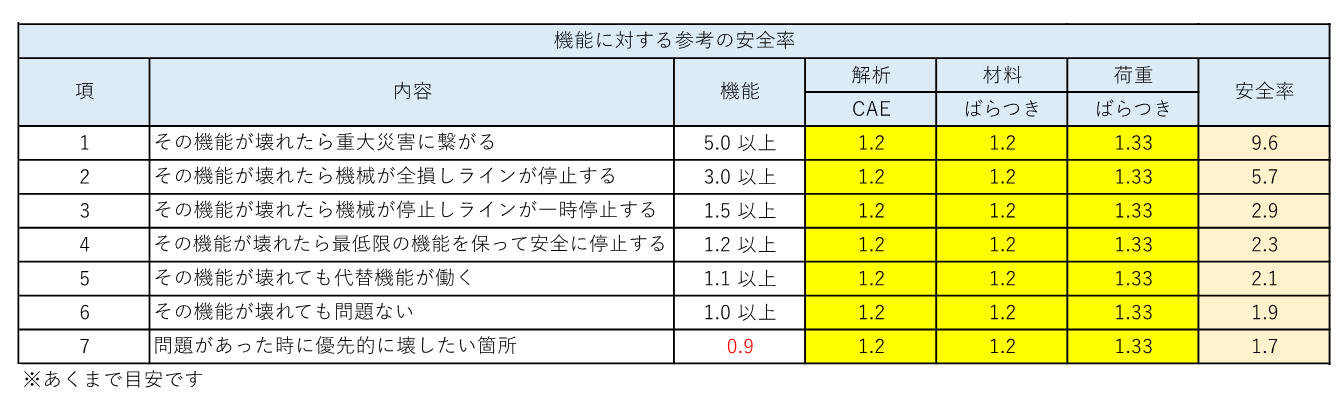
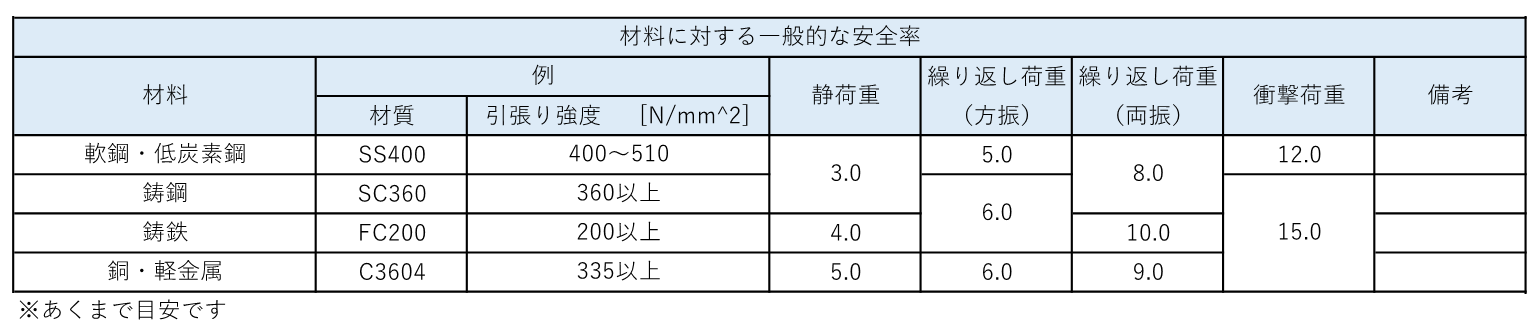
Reference Article:Safety factor guidelines for use in mechanical design Excerpted from
This is for reference only.If a purchased item is available that can be used as a stopper,Many companies go with one size larger if space allows. I think.
About Shock Mitigation and Design
Next, I would like to add something about impact mitigation. There are two major candidates for mitigating the impact of workpiece collisions.
- Decelerate in front of you.
- Use absorber (damper)
If the workpiece is light, it can be applied directly to the stopper, but if the workpiece is heavy, it can be slowed down in front of the stopper to prevent it from being broken by the impact, or if the impact on the stopper is still high, an absorber can be used to mitigate the impact.
Just,Not suitable for locations that are frequently hit because the absorber will wear out It seems.In fact, SMC's catalog includes the following note in its catalog
Partial quote (https://www.smcworld.com/assets/manual/ja-jp/files/RB-J.pdf)
The warranty period for our products is from the start of use.Within 1 year or 1.5 years after delivery, whichever comes first The number of times the product can be used is the same as the number of times it has been used. Some products have specified endurance, mileage, replacement parts, etc. Please check with our nearest sales office.
Maximum frequency of use
Design under conditions where the product will not be used more frequently than the maximum frequency of use indicated.5) Size selection
Shock absorbers are,As the number of uses progresses, the maximum amount of energy absorbed decreases due to deterioration of the internal hydraulic fluid and wear of internal parts. The following is a list of the most important factors to be taken into account. Consider this,Size selection with a margin of 20% to 40% of the energy absorbed is recommended (Note) The following is a list of the items that will be handled by the Company. (Attention.) The number of usable operations (life cycles) within the catalog specification range should be as follows.
- 1.2 million cycles RB0604, RB08□□□
- 2 million cycles RB10□□□~RB2725
Lifetime counts (appropriate replacement time) are values at room temperature (20-25°C). The number of times it should be replaced may vary depending on temperature conditions and other factors,Replacement may be required even within the number of operations listed above.
In other words, if you use shock absorbers on conveyors or other frequentFrequency, total number of times, and atmosphere need attention. It is.(You can use it not for conveyors, but for contingencies, such as servo-driven overrunning mechanical stoppers, for example.)
Also, these stoppers areIt is better to design the structure for easy replacement. I think it is a good idea.
Download Calculation Sheet
Here you can download the calculation excel for the above calculations. Please feel free to customize and use it as you wish.


That's it.
- RELATED:Design method
- RELATED:Conveyor