Here, the drafted drawing"How to inspect drawings, how to think about it, and specific items to check." Here is a note about the
I wrote assembly and parts drawings. The later process is drawing inspection.The specific items to be checked in this inspection process vary from company to company and from draftsman to draftsman, and there are no specific rules.
For this reason, some companies use check sheets, while others leave it up to the draftsman to check the drawings.I have seen and written hundreds of drawings in the past.There are three major important points that should not be overlooked We believe that this is the case.
- Drawing inspection is the process of looking back at drafting
- Inspection of drawings to ensure conformity to applicable standards
- Inspection of drawings to ensure that they are in accordance with a specific situation.
It is.I think they are all basic, but as I said before, there are no fixed rules for inspecting diagrams.
And this probing diagramOne of the practices that we want inexperienced designers and drafters to master early in their careers. So, in this article, those people will beNote in sequence the tasks to be performed in a drawing with the aim of learning to perform self-drawing properly. I will try to do so.
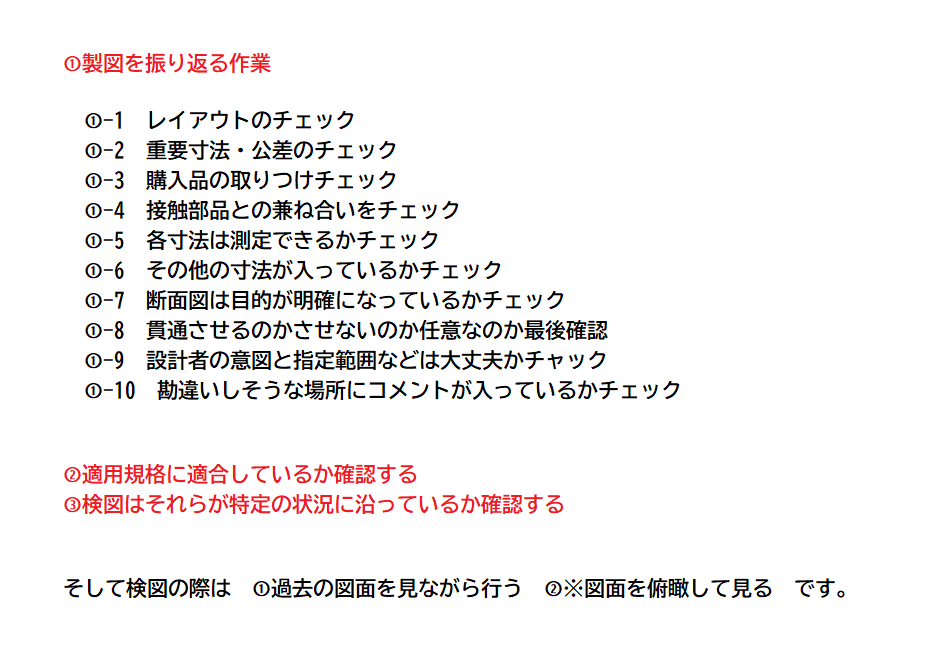
- How to do a drawing
- (1) Work to reflect on drafting
- ①-1 Layout check (required)
- ①-2 Checking important dimensions and tolerances (required)
- Installation check of purchased items (required)
- ①-4 Check for compatibility with contact parts (required)
- ①-5 Check if each dimension can be measured (required)
- ①-6 Check if other dimensions are included (required)
- ①-7 Check if the cross sectional drawing has a clear purpose (required)
- (1)-8 Last check whether it is optional to penetrate or not (Important)
- ①-9 Chuck (required) that the designer's intention and the scope of specification, etc. are okay.
- ①-10 Check for comments in places where they might be mistaken (required)
- (2) Check for conformity to applicable standards
- (iii) Inspection diagrams confirm that they are in accordance with the specific situation (optional but important).
- (1) Work to reflect on drafting
- Supplemental: For more effective charting
- Finally.
How to do a drawing
(1) Work to reflect on drafting
The first step is to check every part of the drawing.
Here, we will skip the basic checks, such as title checks, forgetting to include dimensions, materials, materials, various treatments, etc., and pick up only the important points.
①-1 Layout check (required)
First, take a broad view of the entire area and check that the display layout has been properly selected.
- Is the selection of the figure frame appropriate?
- Is the choice of scale appropriate?
- Are the parts properly oriented (do they make good use of the figure frame?)
The key points of how to select the figure frame and scale are
[Citation.Drawing scales recommended by JIS and practical drawing scales
In my opinion.Because text interferes with shape recognition, the approximate figure frame can be determined by the balance between the size of the text and the model. I was thinking,It is difficult for some things to be expressed in the present scale (1:1) for assembly drawings,The first candidate for the scale to be used for the parts drawing is the size of the drawing frame that can be drawn at 1:1. and year,Any A1 to A4 butIt is best to select a size that fills about 70-80% of the parts in the figure frame. I think it is.
Here it is.
①-2 Checking important dimensions and tolerances (required)
Next,Compare assembly drawings and assemblies with parts drawings Important dimensions, dimensional tolerances, if necessaryGeometric Tolerance Check first to see if it contains I will do so.
Installation check of purchased items (required)
Next, make sure that you are putting in the items according to the catalog of the items you are purchasing.If you only look at the parts and include dimensions, you will not be able to check the purchased items that will be attached to the parts.
One of the most common drafting errors is that tolerances are set in a different direction than the positioning direction of the purchased product,It is essential to check this section against the catalog of purchased items unless otherwise stated!(When drafting a parts drawing, it is helpful to have an excerpt from the catalog of the item to be purchased, so the draftsman and inspector can double-check.)
①-4 Check for compatibility with contact parts (required)
Make sure that the purchased items are attached,Check dimensions and tolerances of adjacent parts by comparing them with each other. I will do so.Mechanical parts have parts that fit together, and if they are not within each other's tolerances, they cannot be assembled. In other wordsInspection drawings are not completed piece by piece. That is to say.
①-5 Check if each dimension can be measured (required)
The above items show that each component is properly attached to each other, though,We cannot guarantee that we will be able to measure those dimensions.
Citation:https://www.mitutoyo.co.jp/story/
Mitutoyo's QuotesWhether you can make it or not is whether you can measure it." As the saying goes, "Whether you can make it or not is whether you can measure it or not,As a common dimensioning error,In some cases, reference dimensions used for assembly are converted to parts drawings to create parts drawings that are not measurable (or cannot be measured without substitutions).
Checking dimensions in drawing inspections is done byIt's not a question of "with or without dimensions," but of making sure it's coming out of where it needs to be and that it's measurable. Also, by comparing the assembly model with the parts drawing, it is possible to confirm that the tolerances are appropriate for the mounting method and orientation.
I'll discuss what this test can do in another article.How to draw parts diagrams with measurement in mind Please see the summary in the following table.
①-6 Check if other dimensions are included (required)
Here at last.Check if other dimensions are included. I will do so.
①-7 Check if the cross sectional drawing has a clear purpose (required)
Next, based on the idea that detailed drawings without purpose are unnecessaryWhat do you want the cross section to show? Was it necessary to make the cross section in the first place? Hang a review of the
(1)-8 Last check whether it is optional to penetrate or not (Important)
After the drawing is submitted, we often receive inquiries such as, "Is it possible to make the stop hole penetrate through the bottom hole? Such as.
In designing machine parts, it is sufficient to have the required plate thickness, the required hole, and the required depth.As a machinist, you do not want to use a shape that requires more work from the back or fewer tool changes, and the more processes you add, the more risk you take.Make sure that the shape is flexible during this inspection phase.
Example: For halfway depths, use the notation "Can be penetrated through the preparation hole" or "Can be tapped through.
①-9 Chuck (required) that the designer's intention and the scope of specification, etc. are okay.
This is mainly due to the fact thatHeat treatment and surface treatment, and the accuracy of the part. means "a person who is a member of a group of people who are not members of a group.For example, heat treatment allows partial treatment, and surface treatment can be partially masked, depending on the type of treatment.
andIf you're asking if all of those parts need that treatment, there are some parts that don't. It is. Given that, after processingsurface roughnessis also listed as a target of the range designation.
For example, when using a stepped rod as a rotary shaft, the surface roughness of the part where the bearing hits and the part where it does not should strictly speaking be different. Conversely, from the manufacturer's point of view, is that necessary? If it is necessary, it will increase the time and cost. ・・・・It is important to do the inspection with the idea that
It is also important in inspection drawings to understand the designer's intentions and to check with the designer as necessary, andThe fact that you didn't compare your assembly drawings with the assembly drawings or that you didn't know this was possible should be avoided in the inspection drawings. I believe that this is the case.
①-10 Check for comments in places where they might be mistaken (required)
The key to drafting and inspection is to be objective. That is to say.
What the drafter/inspector understands may not always be understood by others. Therefore, we check for expressions that can be more easily understood by adding comments to places that seem incongruous or unclear from an objective point of view.
For example, upstream and downstream marking, or marking multiple types of holes at different locations (e.g., hole a) (hole b), etc.
Most post-drawing inquiries can be avoided with comments like these.
(2) Check for conformity to applicable standards
This is to ensure that it is in accordance with each industry's standards and end-user's own standards. The main items areReview of purchase specifications and other documents It is.
What we care about in this item is whether each part conforms to the rules and environmentally friendly specifications for materials, surface treatment, heat treatment, coating, etc. It is.
For example, in the case of 3DCAD, it would be somewhat easier if the specifications were displayed in the properties during the design process and these were automatically quoted in the parts drawing,There's no guarantee that they'll be careful. Final check at the time of drawing inspection.to the "I" in the following paragraphs.
(e.g.) Material information is on the parts drawing, but I have not been told that this is correct, so let's check again with the designer himself.
Example: Will this treatment ride well on this material? Let's check again with the designer → 0
(iii) Inspection diagrams confirm that they are in accordance with the specific situation (optional but important).
Finally, a final review is made to determine what kind of cueing is the subject of the inspection.
Specify if this drawing is an official release drawing or a confirmation drawing for approval, and if necessary, what the purpose of the drawing is. I will do so.If you are just going to submit a drawing, it is not necessary to specify these details, but if necessary, include a description of the condition if it is missing.
Supplemental: For more effective charting
In performing the inspection,The obvious but effective ways to do this are (1) to look at past drawings and (2) to look at drawings from a bird's eye view. There areBy looking at similar drawings in the past, it becomes easier to adopt inconsistencies and optimal expressions, such as expressions in the drawings,It is easier to spot mistakes by looking at a printed drawing from a bird's eye view or even a PDF check by looking at the whole picture in a blurry view.
Please refer to the opinion articles of those who check output and those who do not check output for this section.
→directional marker or indicatorAbout 80% of drawings are printed on paper and only 20% are paperless.
Finally.
Finally, we summarize the order of the inspection.
(1) Work to reflect on drafting
①-1 Layout check
(1)-2 Checking important dimensions and tolerances
(1)-3 Installation check of purchased items
(1)-4 Check for compatibility with contact parts
(1)-5 Check if each dimension can be measured
Check if other dimensions are included.
①-7 Check if the cross sectional drawing has a clear purpose.
(1)-8 Last check whether it is optional to penetrate or not
(1)-9 Designer's intention and specified range, etc. are ok Chuck
①-10 Check for comments in places that might be misunderstood.
(2) Check for conformity to applicable standards
(iii) Inspection drawings confirm that they are in line with the specific situation.
And when inspecting drawings, (1) look at past drawings, and (2) look at the drawings from a bird's eye view.
We will continue to need to draw drawings, but it is important to recognize that design includes inspection drawings.And since the items to be checked in this inspection drawing are checks of things to be noted when drawing the parts drawing,It is a very interrelated process: if you are good at inspecting drawings, you will be good at drawing parts, and if you are good at drawing parts, you will be good at inspecting drawings.
That's it.
-

-
Introduction to Mechanical Drawing
Here, I would like to leave a note as an introduction to mechanical drawing, "Thorough Explanation from Basic Rules to Drawing Methods". In mechanical drafting, I have been wondering if I can really convey the ...
See more.
