Today, we are going to discuss the "About the self-locking gear mechanismA note on "The
In machine design, we consider mechanisms to elevate or rotate heavy objects in one vertical direction, but when this happens, the objects to be transported may fall or rotate backwards, creating a dangerous situation. To prevent this from happening, we designersA self-locking mechanism, which prevents automatic reverse rotation, may be selected.
This article notes representatives of that self-locking mechanism and its features.
About Self-Locking
The self-locking of a gear mechanism is specifically a mechanism to prevent reverse rotation of the gears, meaning that the output side turns when turned from the input side, but the input side does not turn when turned from the output side. This allowsUnintended movement or reverse rotation is prevented.
Self-locking gear mechanism
Gear mechanisms that are self-locking include the following
(1) Worm gear structure
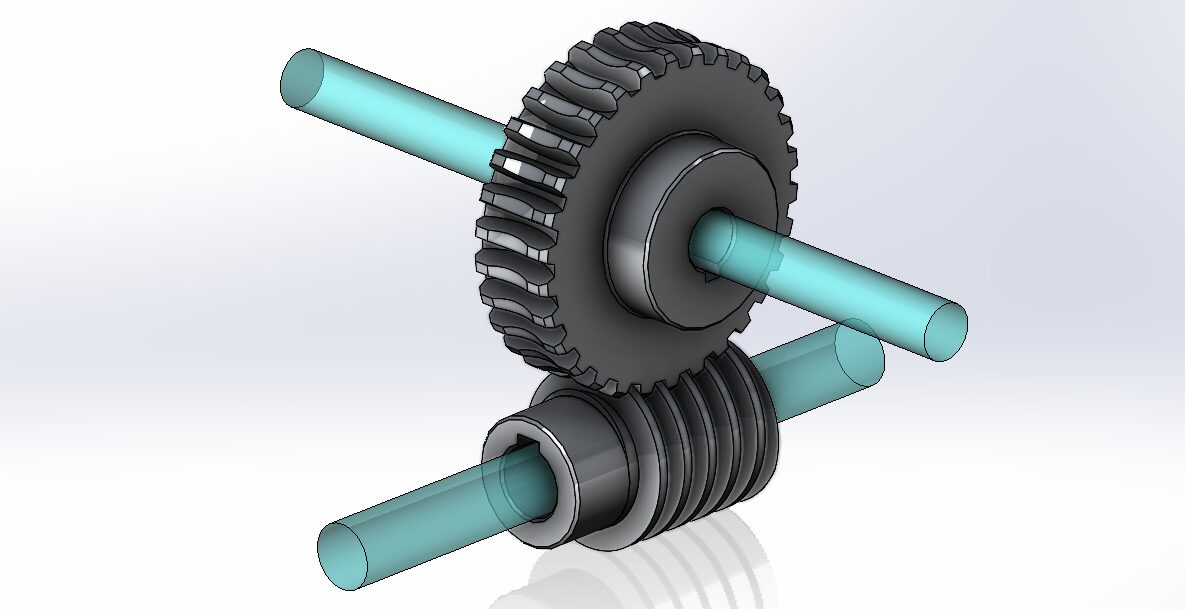
A worm gear is a mechanism consisting of a spiral worm (threaded gear) and a worm wheel (gear). This gear provides a high reduction ratio and has a self-locking function because the worm wheel cannot drive the worm in the opposite direction under certain conditions.
This is how the gear manufacturer describes the self-locking of this worm gear.
Self-locking properties:Sumitomo Heavy Industries, Ltd.
When the reversing efficiency is zero or negative, a high-speed shaft cannot be driven from a low-speed shaft. This is called self-locking.Check for self-locking if necessary. Self-locking is usually defined as the inability to be driven from a low-speed shaft in a stationary state. However, self-locking is not a guarantee against reverse rotation, as it is affected by the state of friction in the gear mesh.
Self-locking:Kyoiku Gear Industry Co.
This phenomenon refers to the inability to drive the worm from the worm wheel.Theoretically self-locking at an advance angle of 4° or lesswill be.
Self-locking:Aoki Seimitsu Kogyo Co.
Self-locking (automatic clamping), a feature of worm gears, means that they do not turn from the output side (do not reverse) when the reducer is stopped. Theoretically, self-locking works when the advance angle of the worm is less than the friction angle. However, this may be uncertain due to the state of lubrication, the state of the tooth surface (surface roughness, degree of familiarity), instantaneous changes due to shock or vibration, and other frictional resistance. Therefore, in our company,Self-locking with an advance angle of 4° or lessThe Company has set the following as
Thus, while self-locking worm gears are effective, there are some that are less effective or ineffective, soIt cannot be said that worm gear = self-locking works.
These worm gears can be purchased separately and should be selected according to your design. (If you are looking for:Kyoiku Gear Industry Co.、Obara Gear Industryetc.)
(2) Ratchet gear structure
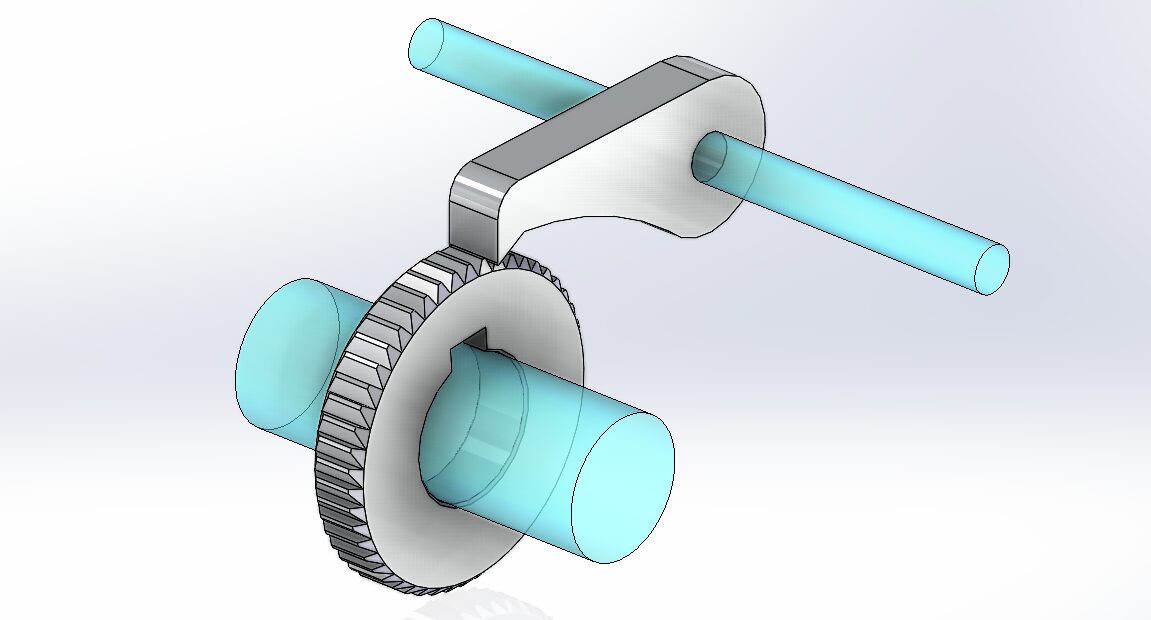
Since ratchet gears are designed to rotate only in one direction, reverse rotation is basically impossible. Since most ratchet mechanisms are used as tools, they are not often incorporated into machines, but they function reliably as self-locks.
This ratchet can also be purchased and used commercially. (If you are looking for:Kohara Gear Industry (SRT Series)etc.)
High reduction ratio structure
Self-locking is uncertain due to frictional resistance, friction angle, and external vibrationHowever, a gear mechanism with a high reduction ratio is also considered to have a self-locking function.
In a reduction mechanism, a small force applied to the input side usually helps to transmit a large force to the output side, but conversely, if a force is applied from the output side, the force required to actually turn the unit becomes very small when that force is transmitted to the input side. There is also the effect of inertia. If the reduction ratio is high, the inertia of the rotating parts on the input side increases.
The motor + reducer structure reduces the power in the case of reverse rotation so much that it is stopped by a small electromagnetic brake attached to the motor, even though it would normally turn from the output side.
Equipment with built-in self-locking
Screw jacks (excluding some)
Screw jacks made with worm gears and trapezoidal screws have a self-locking function that works at any position within the stroke. However, high lead screw jacks that are designed for high speeds do not have a self-locking function, so it is necessary to confirm whether they have a self-locking function before use.
Worm reduction gears
A stand-alone reduction gear incorporating a self-locking worm gear (gearboxes are also commercially available) has the ability to prevent reversal from the output side when stopped.
The same applies here. Not all worm reduction gears have a self-locking function when used, and the state of lubrication, impact on the tooth surface, and momentary changes due to vibration may also make self-locking uncertain, so it is necessary to check whether self-locking functions for each model at the manufacturer that provides the gear.
That's it.